

Indigenous Relations
Moccasin Identifier initiative Partnership

Contact Us
For more information or questions contact:
Moccasin Identifier initiative Partnership with the City of Hamilton
The City of Hamilton and the Moccasin Identifier initiative partnership is a groundbreaking moment and the first of its kind for the non-profit organization. The goal is to share Indigenous educational content and public art around the city of Hamilton.
Treaty Markers
To date, the City of Hamilton has installed three Indigenous Treaty Markers across the city as part of a public art and education initiative to provide residents with an opportunity to learn more about Indigenous Peoples and our shared history.
The markers honour the history, rights, languages and cultures of First Peoples of Canada. Made from granite, each marker is inspired by a historical and unique moccasin design that represents a unique Indigenous culture and tradition. The markers use moccasin artwork and interpretive plaques to their stories and encourage residents to pause, reflect and learn more about our shared responsibility to advance reconciliation.
Alignment to Urban Indigenous Strategy
This partnership between the City of Hamilton and Moccasin Identifier ties directly to actions from the Urban Indigenous Strategy, especially:
- Action 11: Incorporate more Indigenous stories and voices into the City of Hamilton’s culture and heritage plans.
- Action 22: Commission public art in a prominent location that honours mutual respect and the spirit of reconciliation.
- Action 23: Bring together partners to offer public education to all residents about the history of Indigenous people and current topics that will contribute to reconciliation. This public education program should include highlighting local Indigenous resources and museums and promote awareness of national holidays such as National Indigenous Peoples Day and the National Day for Truth and Reconcilation.
Learn more about the Urban Indigenous Strategy.
Residents can view the Treaty Markers at the following locations:
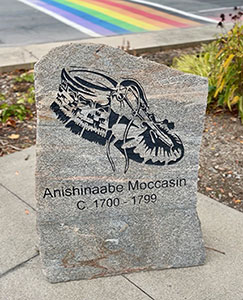
This Treaty Marker features an Anishinaabe moccasin from the period 1700 to 1799 CE. It honours the Anishinaabe Peoples, whose ancestral territories span much of Ontario and the Great Lakes region.
Inspired by an 18th-century pair of moccasins from the Bata Shoe Museum, the design reflects the craftsmanship, cultural traditions and connections shared among First Nations through trade, diplomacy and alliances. The marker highlights the importance of caring for the land, maintaining relationships and honouring shared responsibilities rooted in Indigenous traditions.
The marker reminds residents of the enduring presence of Anishinaabe Peoples and the importance of respecting Treaty relationships and responsibilities today.
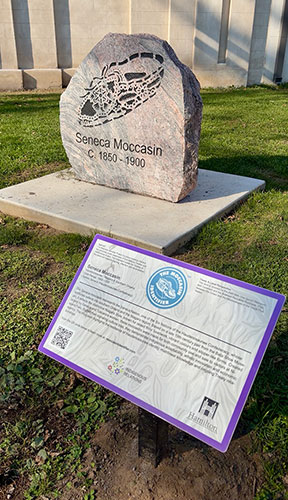
Representing the Seneca Nation of the Haudenosaunee Confederacy during the period 1850 to 1900 CE, this treaty marker is inspired by a late-19th-century pair of moccasins from the Bata Shoe Museum. The design features colourful floral beadwork and elements associated with the Niagara Style. It reflects the craftsmanship of First Nations artisans, particularly Seneca and Tuscarora women.
The marker highlights how Indigenous makers adapted to changing economic conditions while preserving their cultural identity, traditions and knowledge. It also reminds residents of the enduring presence of Haudenosaunee Peoples and their ongoing Treaty relationships and responsibilities.
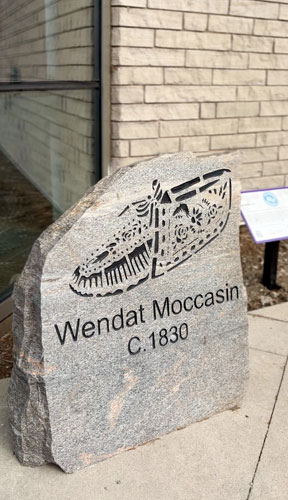
This Treaty Marker represents the Wendat people from approximately 1830 CE, whose ancestral homelands include much of southern and central Ontario.
Historically known for their leadership in trade, agriculture and diplomacy, the Wendat maintained their cultural traditions and connections to the land despite displacement and the impacts of colonial expansion.
The moccasin symbolizes Wendat resilience, cultural identity and craftsmanship, blending traditional Indigenous techniques with materials introduced through trade. The marker encourages residents to reflect on the enduring connections Indigenous Peoples have to the land and our shared responsibility to honour Treaty relationships.
The Next Phase
In late 2027, each Treaty Marker throughout the city will be updated with information directing visitors to the Treaty Place. The Treaty Place will serve as a dedicated gathering space and will provide an opportunity to learn about the Indigenous Peoples of this land in which we stand today. The space will also support future activities designed to build Treaty awareness and deepen understanding of Treaty responsibilities, Indigenous relationships to the land and the history of Treaties, including the promises made and broken.
Date modified