
Home

"I want to" Navigation

  • apply
    Apply & Report
    • Report a problem
    • Vacant Unit Declaration
    • Building Permit
    • Business Licence
    • Jobs at the City
    • Property Tax eBilling
    • Recreation Programs
    • Subsidized Housing
    • View more...
  • pay
    Payments
    • Administrative Penalty Notice
    • Cat Registration
    • Dog Licence
    • Parking Penalty Notice
    • Property Tax
    • Provincial Offences Notice
    • View more...
  • calendar
    Reserve & Book
    • Building Inspections
    • Event Planning & Rentals
    • Golf Tee Time
    • Hamilton Sign Lighting
    • Paramedic & Ambulance
    • Respiratory Vaccine
    • Routine Vaccine
    • View more...
  • register
    Get Involved
    • Council & Committee Meetings
    • Delegate at Council
    • Engagement & Consultation
    • Livestream - Council Chambers
    • Livestream - Room 192/193
    • Livestream - Room 264
    • Lobbyist Registry
    • View more...
  • learn
    Stay Informed
    • Ask a question
    • Contact Us
    • City News & Notices
    • Frequently Requested By-laws
    • HSR Schedules & Detours
    • Lane Restrictions & Road Closures
    • Subscribe to E-Updates
    • Waste Collection Schedule
    • View more...

Hamilton Search

Main navigation

  • people People & Programs
    • Adults 55+ Services
      • Age Friendly Hamilton
      • Senior and Older Adult Resources
    • CityHousing Hamilton
      • About CityHousing Hamilton
      • Applicants
        • Application Process
        • Housing Search
        • Market Rent Housing
      • Development & Revitalization
        • Asset Renewal
        • Development Stories
          • 257 King William Development
          • 8 Roxanne Dr: A Sustainable Step Forward for CityHousing Hamilton
          • Eastern Canada’s first volumetric modular high-performance building
          • Hamilton is Home Initiative
          • Sensitive infill development creates 55 homes
          • World’s largest residential Passive House EnerPHit retrofit
        • Development Projects
          • 106 Bay St. N
          • 1620 Main St E
          • 263 Main St E
          • 405 James St N
          • 500 MacNab Street North
          • 55 Queenston Rd
          • 58 Macassa Ave
          • 8 Roxanne Dr
          • 257 King William Street
      • Tenants
        • Complaint Resolution
        • Housing Support Programs
        • Maintenance and Repairs
        • Paying Your Rent
        • Pest Control - CityHousing Hamilton Request
        • Safe Apartments
        • Tenant Accessibility Survey
        • Tenant Safety
        • Tenants First Team
    • Community Funding & Grant Programs
      • Building Safer Communities Grant
      • City Enrichment Fund
        • CEF Agriculture Program
        • CEF Arts Program
        • CEF Communities, Culture & Heritage Program
        • CEF Community Services Program
        • CEF Digital Program
        • CEF Environment Program
        • CEF Sport & Active Lifestyles Program
        • CEF Appeals Process
      • Downtown Hamilton Creative Placemaking Grant
      • Hamilton Future Fund
    • Early Years & Child Care
      • Child Care Services
        • Child Care Registry
        • Child Care Subsidy Calculator
        • Financial Support for Child Care
        • Ontario Child Care Tax Credit
        • Red Hill Family Centre
      • Early Childhood Education
      • Early Years Services
        • Early Years Community Plan
        • Early Years Programs & Services
        • EarlyON Child and Family Centres Locations
    • Financial & Stability Supports
      • Ontario Works
        • Apply for Ontario Works
        • Access your file with MyBenefits
        • Receiving Ontario Works
      • Support Programs
        • Learning, Earning and Parenting Program (LEAP)
        • Dental & Denture Services
        • Free Menstrual Products
        • Funerals, Burials & Cremations
        • Home Management Program
        • Special Supports Program
        • Snow Clearing Subsidy
        • Holiday Registry
    • Hamilton Municipal Cemeteries
      • Planning Ahead
        • Guide to Services & Merchandise
        • Pre-Planning
        • Start The Conversation
      • Cremation & Burial
        • Burial Options
        • Cremation Options
        • Family & Pet Burial
        • Field of Honour
        • Natural Burial
      • Products & Services
        • Historical Family Search
        • Memorialization Options
        • Monuments & Markers
        • Personalization Options
        • Service Options
      • Our Cemeteries
        • Cemeteries By-laws
        • Cemeteries Directory
        • Cemetery Events
        • Historical Walking Tours
        • Remembering Services
    • Housing & Shelter
      • Housing Services
        • Applicant and Tenant Review
        • Housing Provider Information
        • Priority Applications
        • Social Housing
      • Housing Supports
        • Canada-Ontario Housing Benefit
        • Emergency Repair Program
        • Eviction Prevention
        • Housing Allowances
        • Housing Emergency Fund
        • Ontario Renovates Programs
        • Rent Secure
        • Residential Care Facilities Subsidy Program
        • Veteran Homelessness Program
      • Preventing & Ending Homelessness
        • Emergency & Violence Against Women Shelters & Drop-in Programs
        • Winter Response Strategy
        • Approved Temporary Shelter Expansion
        • City of Hamilton Encampment Protocol
        • Encampment Response
        • Former Cathedral Boys School
        • Hamilton’s Homelessness Ending Strategy
        • Housing & Homelessness Action Plan
        • Point in Time Connection
        • Resources for Homeless-serving Partners
        • Resources for Individuals at Risk of and Experiencing Homelessness
      • Tenant & Landlord Resources
        • Fire Safety for Rental Properties
        • Landlord Information
        • Landlords Role in Hot Weather
        • Register a Tenant By-law Complaint
        • Rent Supplement Program for Landlords
        • Rental Property By-laws
        • Safe Apartments Buildings Program
        • Second-hand Smoke in Shared Housing
        • Tenant Defence Fund Pilot Program
        • Tenant Information
        • Tenant Support Program
    • Inclusion, Diversity, Equity & Accessibility
      • Indigenous Relations
        • Indigenous Dates of Recognition
          • National Ribbon Skirt Day
          • National Indigenous Languages Day
          • National Day of Awareness for Missing and Murdered Indigenous Women and Girls
          • National Indigenous History Month
          • National Indigenous Peoples Day
          • National Day for Truth and Reconciliation
          • Treaties Recognition Week
          • International Inuit Day
          • Indigenous Veterans Day
          • Louis Riel Day
        • Land Acknowledgement
        • Urban Indigenous Strategy
        • Urban Indigenous Strategy Implementation Plan
        • Indigenous Landmarks & Monuments Review
        • Indigenous Events & Initiatives
        • Indigenous Hub
      • Accessibility Services
        • Accessibility Feedback/Complaint Form
        • Accessibility Guidelines & Policies
        • Multi-Year Accessibility Plan
      • Charter of Rights of Children & Youth
      • Jewish Life in Hamilton
      • Salam Hamilton
    • Long-term Care
      • Macassa Lodge
        • Macassa Lodge Redevelopment
      • Wentworth Lodge
    • New to Hamilton
      • Hamilton Welcomes Ukrainians
      • Healthcare in Hamilton
      • Housing for Newcomers
        • Hamilton Housing Guide
        • Low Income Housing
        • Purchasing a Home
      • Settlement Services for Newcomers
      • Studying in Hamilton
        • After Graduation
        • Arriving in Hamilton
        • Before You Arrive
        • Connect to Your City
    • Outreach & Education
      • Forestry Outreach & Education
        • Forestry Community Events
        • Forestry School Presentations
      • Museums Learning Adventures
      • Waste Management Outreach & Education
        • Waste Collection Safety
        • Waste Facilities Educational Videos
        • Waste Management Community Education
        • Waste Management Student Education
      • Water Outreach & Education
        • Children's Water Festival
        • Water Education Resources
        • World Toilet Day
    • Public Health
      • Alcohol, Drugs & Gambling
        • Alcohol & Drugs
        • Alcohol, Drug & Gambling Services
        • Hamilton Opioid Information System
        • Harm Reduction Services
          • Drug Checking
          • Harm Reduction Supplies
          • Naloxone Kits
          • Street Health Clinics
          • The Van Needle Syringe Program
      • Breastfeeding
        • Breastfeeding Supports
        • Feeding Your Baby
        • Hamilton’s Breastfeeding Coalition
        • Breastfeeding Information
      • Community Health Data
      • Dental Health
        • Emergency Dental Services
        • Oral Health Information
        • Children's Dental Health
        • Adult & Senior's Dental Health
      • Diseases & Conditions
        • Ebola Virus Disease (EVD)
        • Group A Streptococcus (GAS)
        • Respiratory Illnesses
          • Protect Yourself and Others
          • Respiratory Vaccines
          • Respiratory Virus Data
          • Testing & Treating Respiratory Illnesses
        • Tuberculosis
        • Viral Encephalitis & Meningitis
      • Environmental Health & Hazards
        • Air Quality in Hamilton
        • Animal & Insect-related Diseases
          • Avian Influenza - H5N1
          • Rabies
          • Tick Types, Bites & Removal
          • West Nile Virus
        • Cold Alerts & Community Response
        • Environmental Illnesses
          • Lead
          • Legionnaires' Disease
          • Radon
        • Heat Warnings & Heat-Related Illness
        • Safe Water Program
        • Sun Safety
      • Food & Nutrition
        • Learning to Cook
        • Monitoring food affordability in Hamilton
        • Feeding Your Baby & Children
        • Healthy Snacks for Sports
      • Food Safety
        • Food Safety at Home
      • Health Care Professionals
        • Dental Programs & Clinic Resources
        • Outbreak Reporting & IPAC for Congregate Living Settings
        • Prenatal, Family & Child Health Referrals
        • Reporting Infectious Diseases
          • Rabies Reporting & Vaccines
          • Tuberculosis Reporting, Guidelines and Resources
        • Sexual Health and Sexually Transmitted Blood-borne Infections
        • Smoking & Substance Use Referrals
        • Vaccine Ordering, Cold Chain & Adverse Events Reporting
      • Health Inspection Results
        • Convictions & Orders in Hamilton
        • Infection Prevention and Control (IPAC) Investigations
      • Healthy Pregnancy
        • Mental Health During & After Pregnancy
        • Prenatal Healthcare
        • Prenatal Supports
          • Welcome Baby Prenatal Nutrition Program
            • Welcome Baby Members
        • Having a Healthy Pregnancy
        • Home Visiting Programs
      • Healthy Schools
        • Child and Youth Health Atlas
        • Health Resources for Schools
          • Food and Nutrition in Schools
          • Growth, Development & Sexuality
          • Healthy & Equitable Schools
          • Mental Health Promotion
          • Personal Safety & Injury Prevention
          • Physical Activity Resources
          • Positive School Environment
          • Sedentary Behaviour
          • Substance Use & Harm Reduction
          • Sun Safety, Shade and the Importance of Trees
          • Tobacco & Vaping
        • Planning for a Healthy School
        • Public Health Services in Schools
          • Public Health Nurses in Schools
          • School Dental Screening
          • Visual Health Information for Schools
      • Mental Health
        • Child & Adolescent Services
        • Mental Health & Street Outreach Program
      • Parenting
        • Children's Mental Health
          • Attachment & Relationships
          • Brain Development
          • Parent & Caregiver Well Being
        • Parenting Groups in Hamilton
        • Car Seat Support
        • Child Safety
        • Children's Growth & Development
        • Parenting Toddlers and Preschoolers
        • Parenting Babies
        • Parenting School Aged Children
          • Bullying
          • Head Lice
          • Screen Use & Online Safety
          • Sexual Health & Puberty
          • Welcome to School
          • Youth Vaping & Smoking
      • Physical Activity
      • Public Health Services Annual Report
      • Sexual Health
        • Sexual Health Clinics
        • Sexually Transmitted Infections
        • Contraception
      • Smoking & Vaping
        • Quit Smoking
        • Second-hand Smoke
        • Secondhand Smoke and Pets
        • Smoke & Vape Free Spaces
      • Vaccines & Immunizations
        • Community Vaccine Clinic
        • Respiratory Illnesses
        • Vaccine Safety
        • Vaccines & Children
        • Reporting Vaccinations
        • School Vaccine Clinics
        • School Screening & Suspensions
        • Vaccine Exemptions
        • Vaccine-Preventable Diseases
          • Bacterial Encephalitis & Meningitis
          • Chickenpox
          • Herpes Zoster (Shingles)
          • Measles
          • Meningococcal Disease
          • Mpox
          • Mumps
          • Pertussis or Whooping Cough
          • Respiratory Syncytial Virus (RSV)
      • Visual Health
    • Youth Services
  • home Home & Neighbourhood
    • Animals & Pets
      • Adopt or Foster a Pet
        • Adoptions
        • Foster an Animal
      • Responsible Pet Ownership
        • Claiming Your Pet from the Shelter
        • File an Animal-Related By-law Complaint
        • Hot Cars and Pets
        • Pet Etiquette on City Properties
        • Responsible Animal Ownership By-law
        • Spay or Neuter Your Pet
        • Vaccinate Your Pet
      • Dogs
        • Dog Parks and Free Running Areas
        • Dog Licence
        • Dog Owners' Liability Act
        • Dog Bite Prevention
      • Cats
        • Community Cats
        • Register Your Cat
      • Lost, Found or Surrender
        • Found Pets
        • Lost and Found Pets
        • Stray Animals
        • Surrendering an Animal
      • Other Domesticated Animals
      • Wildlife
        • Feeding Wildlife
        • Living with Wildlife
        • Sick, Injured or Orphaned Wildlife
      • Volunteer or Donate
        • Volunteer at Animal Services
        • Donate to Animal Services
    • Emergency Services
      • Emergency Preparedness
        • After an Emergency
        • During an Emergency
        • Emergency Information in Different Languages
        • Preparing for Emergencies
          • Tips for Earthquakes
          • Tips for Flooding
          • Tips for Hazardous Materials
          • Tips for Power Outages
          • Tips for Tornadoes
          • Tips for Winter Storms
      • Fire Department
        • About the Hamilton Fire Department
        • Camp FFIT Hamilton
        • Fire Permits, Inspections, Reports and Services
          • Child care Inspections
          • Family Fireworks Sales Permit
          • Filming Related Services
          • Foster Home and Group Home Inspections
          • Open Air Burning Permit
          • Residential and Commercial Inspections
        • Fire Prevention
          • Family Fireworks Safety
          • Fire Prevention on the Farm
          • Holiday Fire Safety
          • Home Fire Safety
          • Smoke Alarms & Carbon Monoxide Alarms
          • Student Accommodation Safety Tips
          • Winter Fire Safety
        • Fire Safety Education, Public Events and Programs
          • Fire Station Tour Request Application
          • Fire Truck Request Application
        • Fire Stations
          • New Waterdown Fire & Police Station
      • Paramedics
        • About the Hamilton Paramedic Service
          • Paramedic & Ambulance Community Engagement Request
        • Medical Priority Dispatch System
        • Make the Right Call in Non-Emergency Situations
        • Medical Emergency Information Program
        • Public Access Defibrillation Program
        • Ambulance Patient Records
        • Hamilton Paramedic Service Master Plan
    • Environmental Stewardship
      • Bird Friendly City
      • Chedoke Creek Remediation
        • Chedoke Creek Spill & Remediation Activities
      • Community Environmental Initiatives
        • Adopt-a-Park
          • Community Improvement Report
        • Community Tree Planting
        • Litter Education
        • Reporting Graffiti
        • Team Up to Clean Up
      • Environmental Plans & Strategies
        • Biodiversity Action Plan
        • Clean & Green Hamilton Strategy
        • Hamilton's Climate Action Strategy
          • Community Energy & Emissions Plan
          • Hamilton’s Climate Change Impact Adaptation Plan
          • Office of Climate Change Initiatives
            • Carbon Budget and Accounting Framework
            • Community Gardens
          • Climate Action Progress
          • Take Action
          • Good News Stories
          • Better Homes Hamilton Program
          • Hamilton’s Climate Change Reserve
          • Priority Focus Areas
        • Office of Energy Initiatives
        • Urban Forest Strategy
      • Our Harbour
        • Hamilton Clean Harbour Program
        • Harmful Algal Blooms
        • Current Clean Harbour Projects
        • Dundas Wastewater Treatment Plant Upgrades
        • Woodward Wastewater Treatment Plant Upgrades
        • Completed Clean Harbour Projects
      • Pollinators
    • Garbage & Recycling
      • Apartment Waste
        • Apartment Blue Cart Recycling
        • Apartment Garbage & Bulk Items
        • Apartment Green Bin & Composting
        • Property Owners, Managers & Superintendents
      • Blue Box & Recycling
        • Blue Box Program Update
      • Business Waste
        • Business Recycling Program Update
        • Single-Use Plastics Business Recognition
        • Waste Collection for Businesses
      • Garbage & Bulk Items
        • Bulk Items and Furniture
        • Garbage
        • Glanbrook Landfill Site
        • Illegal Dumping
      • Green Bin & Composting
        • Backyard Composting
        • Compost Giveaways
        • Composting & Your Green Bin
        • Green Bin
      • Waste & Recycling Facilities
        • Appliances and Scrap Metal
        • Community Recycling Centres
        • Household Hazardous Waste
        • Reuse Shed
      • Waste Collection Schedule
      • Yard Waste
    • Getting Around
      • Biking & Cyclists
        • Active Transportation Benchmarking Program
        • Bike Month
          • Bike Month Registration Form
        • Bike Parking
        • Cargo E-Bike Pilot Program
        • Cycling Groups & Shops
        • Cycling Infrastructure
          • Bay Street Bike Lanes
          • Cannon Street Cycle Track
          • Keddy Access Trail
          • Mountain Climber on HSR for Cyclists
        • Cycling Routes & Maps
        • Cycling Safety & Education
        • Hamilton Bike Share
        • Open Streets Hamilton
        • Personal Use Electric Kick Scooter Pilot Program
        • Shared Commercial Electric Kick Scooter Pilot Program
      • Driving & Traffic
        • CarShare in Hamilton
        • Lane Restrictions & Road Closures
        • Main Street Corridor Renewal and Redesign
        • Municipal Parking Garage Rehabilitation & Summers Lane Reconstruction
        • Permanent Road and Alleyway Closures
        • Queen Street Two-way Traffic Conversion
        • Taxi Services in Hamilton
        • Temporary Road Use Permits
        • Traffic Signals & Signage
        • Truck Route Network
        • Vision Zero - Roadway Safety
          • Distracted Driving
          • Motorcycle Safety
          • Pedestrian Crossovers
          • Rail Safety
          • Rain Road Safety
          • Roadway Safety Tools
          • Roundabouts
          • Safe Stopping
          • Seatbelt Safety
          • Slow Down, Move Over for Emergency Vehicles
          • Speeding & Slow Down Zones
          • Walking on Expressways
          • Winter Driving
      • Parking
        • MTO Accessible Parking Permit Exemptions in Hamilton
        • Municipal Car Parks
          • Reserve a Municipal Car Park
        • On-Street Parking
        • Parking Enforcement
        • Parking Meter or Municipal Lot Parking Request Form
        • Parking Meters & Pay Machines
        • Parking Near Schools
        • Passport Parking App
        • Pre-Holiday Parking
        • Residential Parking on Private Property
        • Temporary Regulation Enforcement
        • Towing
      • School Zones & Safety Tips
        • Active & Sustainable School Travel
          • Active and Sustainable School Travel Event Registration
          • School Site Design Guidelines for Active and Sustainable Transportation
        • Back to School Safety
        • School Crossing Guards
      • Smart Commute
        • Find Your Carpool Match
        • Join Smart Commute
        • Plan Your Trip
        • Smart Commute Events
        • Smart Commute Member Organizations
      • Streets & Sidewalks
        • Complete Street Reports for Wards
        • Pavement Markings
        • Road & Sidewalk Maintenance
        • Sidewalk Snow Clearing
        • Snow Clearing
        • Street Lighting
        • Traffic Island Beautification
      • Walking & Pedestrians
        • Accessible Pedestrian Signals
        • Pedestrian Safety
    • HSR
      • Accessible Transit
        • ATS Eligibility & Registration
        • Accessible Low Floor Buses
        • DARTS
        • Taxi Scrip Program
      • Fares
        • Fares & Photo IDs
        • HSR Fare Assist
        • PRESTO Cards
        • PRESTO E-Tickets Mobile App
        • Pay your Fare with Debit or Credit
        • Transfers & Connections
      • HSR Next
      • Riding with HSR
        • HSR Alert: Real-Time Transit Information
        • HSR At-Stop Solar Lighting Pilot Project
        • Hidden Disabilities Sunflower on HSR
        • Kids Quest Passport
        • Real-Time Bus Arrival Displays
        • Transit from the Airport
        • Using HSR
        • Bikes on Buses
        • Customer Service
        • (Re)envision the HSR
        • HSR Customer Research Panel
      • Schedule & Route Tools
        • Schedules & Detours
        • HSR Holiday Schedules
        • Trip Planning Tools
        • HSR myRide On-Demand
        • Trans-Cab
        • Hamilton Tiger-Cats & HSR
    • Home & Property
      • Basement Flooding
        • Basement Flooding Preparedness
        • Protective Plumbing Devices
        • Protective Plumbing Program
        • Sewer Back-Up and Blocked Drains
      • Home Water Services
        • Advanced Metering Infrastructure Project
        • Frozen Pipes
        • Hamilton Utilities Billing
          • HUB Billing & Payment Options
          • HUB Property, Owner & Tenant Information
          • Reading your HUB Bill
        • Lead Water Service Replacement
        • Lead in Your Drinking Water
        • Low/Poor Water Pressure
        • Service Line Warranty Program
        • Shutting Off Your Water
        • Water Efficient Homes
        • Water Meters
        • Water Rates
          • Stormwater Fee
          • Stormwater Funding Review
        • Water Service Line Replacement
      • Pest Control
        • Bed Bugs in the Workplace
        • Bed Bugs
        • Cockroaches
        • Landlord Pest Control Responsibilities
        • Rats
      • Private Wells & Cisterns
        • Cistern Maintenance & Water Testing
        • Residential Well Decommissioning Grant
        • Private Wells
        • Well Maintenance & Water Testing
        • Well Water After a Flood
        • Arsenic limits in Drinking Well Water
        • Naturally Occurring Lead in Bedrock
        • PFOS and Propylene Glycol
      • Property
        • Encroachment Agreements
        • Lot Grading & Drainage
        • Property Damage
        • Property Survey
        • Property Use By-laws
        • Survey Markings on Your Property
        • University District Safety Initiative
        • Vacant Buildings Registry
      • Trees & Gardens
        • Tree Health Data & Monitoring
        • Tree Ownership & Responsibilities
        • Tree Health
        • Doing Work Near a Tree
        • Tree Giveaway Program
        • Street Tree Planting Program
        • Pesticide Alternatives
        • Rain Barrel Sale
        • Watering Restrictions
        • Water Efficient Lawns & Gardens
      • Water Pollution Prevention
        • Catch Basin & Street Drain Use
        • Downspout Disconnections
        • Emptying Pools & Hot Tubs
        • Flushables
        • Household Fats, Oil and Grease
        • Sewer Inspection Program
        • Spills to the Sewer
    • Property Taxes
      • Municipal Accommodation Tax
      • Property Tax Billing
        • Changes to Your Property Tax Bill
        • Pay Your Property Tax
        • Property Tax Billing By-laws
        • Property Tax Due Dates and Penalties
        • Request for Tax Certificate
        • Sale of Properties for Tax Arrears
        • Tax Assistance Programs
        • Understanding Your Property Tax Bill
        • eBilling for Property Tax
      • Understanding Property Tax
        • Area Rating
        • How Property Tax Rates are Calculated
        • Municipal Tax Competitiveness Study
        • Property Assessment
        • Tax Calculator
        • Tax Impact Mapping
      • Vacant Unit Tax
    • Tickets, Fines & Penalties
      • Administrative Penalty Notice
      • Parking Penalty Notice
      • Provincial Offences Notice
    • Water, Wastewater & Stormwater
      • Stormwater Management
        • Low Impact Development
        • Municipal Drains
        • Stormwater Management Ponds
        • Surface Water Management
        • Surface Water Quality Program
      • Wastewater Collection & Treatment
        • Biosolids Management
        • Monitoring Wastewater Overflows and Bypasses
        • Sewer Lateral Cross-Connections
        • Sewer Systems
        • Wastewater Quality Management System
        • Wastewater Systems
      • Water Treatment & Distribution
        • Community Wells
        • Corrosion Control
        • Drinking Water Quality Management System
        • Drinking Water Quality
        • Drinking Water System
        • Hydrant Flushing
        • Low Level Water Conditions
        • Source Water Protection
          • Septic System Inspection Program
          • Source Water Protection Restricted Land Use Application
        • Water Fluoridation
  • city Build, Invest & Grow
    • InvestinHamilton.ca
    • Buying & Selling with the City
      • Bids and Tenders
        • Blanket and Release Purchase Orders
        • Fair Wage Policy and Fair Wage Schedule
        • Medium-Term Finance & Procurement Solution
        • Procurement Policy By-law
        • Professional and Consultant Services Roster
        • Surplus Items Auction
        • Vendor Information
        • Vendor Performance Management Program
      • Real Estate
        • Housing Opportunities on Municipal Land
          • 5 & 13 Lake Avenue South, Stoney Creek
          • 1126 Garth Street, Hamilton
          • 70 Hope Avenue
          • 115 Campbell Avenue
          • 207 Parkside Drive
          • 299 & 302 Balmoral Ave N & 309 Grosvenor Ave N
        • Opportunity Call for New Police Headquarters & Division 1 Station
        • Inventory of City-Owned Properties
        • Properties for Sale or Lease
          • 10 Cormorant Road, Hamilton
          • 28 James Street North, Hamilton
          • 64 East 31st Street, Hamilton
          • 79 Frederick Avenue, Hamilton
          • 25-35 Trillium Avenue, Hamilton
          • 89 King Street East, Hamilton
          • 205 Lewis Road, Hamilton
          • 272 Sherman Avenue South, Hamilton
          • 350 King Street East, Hamilton
          • 1400 Baseline Road, Stoney Creek
          • 2200 Upper James St, Hamilton
          • Piers 5, 6 & 7 West Harbour Development Blocks
        • Real Estate Portfolio Management
    • Construction & Renovation
      • Construction in Your Area
        • Concession St and Mountain Brow Improvements Project
        • Dickenson Road Sanitary Trunk Sewer Project
        • Lynden Well/ Lynden Treatment Station Upgrades
        • Nebo Road - Rymal Rd E to Twenty Rd E Urbanization
        • Scenic Reservoir Coating and Repairs
        • Stone Church Road Feedermain
      • Residential Building & Renovation
        • Applicable Law for Building Permit Applications
        • Building Permit Application Requirements
        • Building Permit Fees
        • Building Permit Review and Approval
        • Building Inspections
        • Dust Mitigation During Construction & Demolition
        • Hiring a Designer for Building Permit Drawings
        • Property Record Search
        • Residential Construction Requirements for Radon Gas Mitigation
        • Residential Infill Construction
        • Accessory Buildings
        • Additional Dwelling Units (ADUs)
        • Porches and Decks
        • Residential Fences
        • Swimming Pools
        • Tents
        • Building & Demolition Permits Activity
    • Downtown Entertainment Precinct
    • Hamilton Music & Film
      • Filming in Hamilton
        • Apply for a Film Permit
        • Filming Guidelines
        • Information for Residents and Businesses
      • Music in Hamilton
        • Musician Support Programs
        • Street Performers
        • The Anne Foster Windows
    • Housing Secretariat
      • Affordable Housing Development Project Stream
        • Acquisition Program Application
        • Development Program Application
      • Housing Accelerator Fund
        • Additional Dwelling Unit and Multi-Plex Housing Incentive Program
        • Housing Acceleration Incentive Program
        • Rapid Transit Multi-Residential Rental Housing Incentive Program
      • Housing Needs Assessment
      • Partners in Affordable Housing
    • Operating a Business
      • Business By-laws
        • Sign By-law
      • Child Care Licensees
        • Canada-Wide Early Learning and Child Care Agreement
        • Child Care Document Submission
        • Early Years System
        • Fee Assistance
        • Funding Agreements
        • Funding Opportunities
        • Licensee Resources
      • Commercial Water & Sewer
        • Backflow Prevention Program
        • Construction Site and Wastewater Management
        • Sewer Use By-law
        • Small Drinking Water Systems
        • Wastewater Abatement Program
        • Water Hauler
      • EarlyON Child and Family Centre Service Providers
        • Funding Agreements
        • Provider Resources
        • Qualified Teams & Staff Requirements
        • Serious Incident Reporting Policy
        • Services & Responsibilities
      • Health Requirements & Inspections
        • Child Care Centres
        • Cooling Towers
        • Drinking Water Haulers
        • Food Premises & Food Handling
        • Group Homes, Lodging Homes & Funeral Homes
        • Personal Service Settings
        • Public Swimming Pools & Spas
        • Residential Care Facilities
        • Selling Tobacco & E-Cigarettes in Hamilton
        • Smoke and Vape-Free Public Places and Workplaces
        • Tanning Bed Regulation
      • Workplace Policies & Programs
        • Healthy Eating in the Workplace
        • Mental Well-being in the Workplace
        • Physical Activity in the Workplace
        • Smoke & Vape-Free Workplace
    • Planning & Development
      • Planning, Permitting, Licensing & By-Law System
      • Committee of Adjustment & Delegated Consent Authority
        • Agendas & Notices
        • Land Severance (Consent)
        • Minor Variance
        • Process & Participation for Committee of Adjustment
      • Design Review Panel
      • Employment Area Inventory
      • Environmentally Significant Areas Impact Evaluation Group
      • Financial Incentives & Community Improvement Plans
      • Development Charges
        • Community Benefits Charges
        • Development Charges
        • Parkland Dedication Fees
      • Growth Planning (GRIDS)
        • Employment Land Review
        • GRIDS 2 and Municipal Comprehensive Review
        • GRIDS 2/MCR Urban Growth Survey
        • Land Needs Assessment
      • Heritage Properties
        • Built Heritage Inventory Strategy
          • Beasley Heritage Inventory Project
          • Downtown Dundas Built Heritage Inventory
          • Landsdale Neighbourhood Inventory
          • Melville-Park West Heritage Conservation District Plan
          • Places of Worship Inventory Review
        • Heritage Designation Process
        • Heritage Mapping & Resources
        • Heritage Permits
        • Heritage Plaques and Markers
        • Heritage Policies & Guidelines
        • Heritage Windows
        • Municipal Heritage Register
        • Pre-Confederation Buildings
      • Official Plan
        • Market and Land Supply Monitoring Report
        • Neighbourhood Plans
        • Official Plans of Former Municipalities
        • Official Plan Review
          • Conformity Review - Rural & Natural Heritage System Focus
          • Conformity Review - Urban Focus
          • Employment Area Review
          • Major Transit Station Areas
          • Official Plan Review - Local Objectives
        • Provincial Planning Matters
        • Provincial Amendments to the Greenbelt Plan
        • Bill 150 Frequently Asked Questions
        • Rural Hamilton Official Plan
        • Secondary Plans
          • Airport Employment Growth District Secondary Plan
          • Fruitland-Winona Secondary Plan
          • Secondary Planning for Urban Expansion Areas
          • West Harbour Secondary Plan
        • Urban Hamilton Official Plan
      • Planning & Design Studies
        • Bayfront Industrial Area Strategy
        • Dundas Community Node Study
        • Family Friendly Housing
        • James Street North Mobility Hub Study
        • Mountain Brow Vista Study and Management Plan
        • Pleasantview Area Land Use Study
      • Planning Applications
        • Draft Plan of Subdivision or Condominium Approval
        • Formal Consultation
        • Municipal Addressing
        • Official Plan Amendment
        • Part Lot Control
        • Planning Division Fees
        • Rental Housing Protection
        • Site Alteration Permit
        • Site Plan Approval
        • Street Naming & Renaming
        • Urban Boundary Expansion
          • UBE Application: 159 & 163 Sulphur Springs Road
          • UBE Application: Elfrida Secondary Plan
          • UBE Application: Elfrida
          • UBE Application: Twenty Road West Secondary Plan
          • UBE Application: Twenty Road West
          • UBE Application: White Church Secondary Plan
          • UBE Application: White Church
        • Where Development is Happening in Hamilton
        • Zoning By-law Amendment
      • Planning Policies & Guidelines
        • Airport Employment Growth District (AEGD) Wastewater System Capacity Allocation Policy
        • Interim Municipal Support Resolution Protocol
        • Barrier-Free Guidelines
        • City-Wide Corridor Planning Principles and Design Guidelines
        • Complete Streets Design Manual
        • Comprehensive Development Guidelines and Financial Policies
        • Construction and Material Specifications
        • Coordinated Street Furniture Guidelines
        • Cultural Heritage Assessment Guidelines - Documentation & Salvage Report
        • Cultural Heritage Impact Assessment Guidelines
        • Design & Preservation Manual for Assets on Public Property
        • Environmental Impact Statements Guidelines
        • Financial Policies for Development
        • Green Standards and Guidelines for Site Servicing
        • Guide to Coordinating Integrated Planning Processes
        • Guide to Preparing a Conservation Plan
        • Guidelines for Hydrogeological Studies and Technical Standards for Private Services
        • Guidelines for Planning Justification Reports
        • Guidelines for Urban Design Reports
        • Innovative Stormwater Source Control Policy
        • Landscape Design Guidelines for Stormwater Facilities
        • Linkage Assessment Guidelines
        • Masonry Restoration Guidelines
        • Municipal Systems Alterations
        • Park and Open Space Development Guide
        • Public Notice Sign Guide for Planning Act Applications
        • Right-of-Way Utility Installation and Permit Manual
        • Road Widening Dedication Procedure Guide
        • Sewer and Water Permit Process and Design Requirements
        • Sidewalk and Roadway Lighting Policy
        • Site Plan Guidelines
        • Staging of Development
        • Standards and Approved Products Listing and Guidelines
        • Storm Drainage Policy
        • Telecommunication Tower and Antenna Protocol
        • The Gore Standard-Hardscape Design Guidelines
        • Transportation Assessment Guidelines
        • Transit Bus Stop Accessibility Criteria & Guidelines
        • Transit Oriented Development Guidelines
        • Transportation Demand Management Land Development Guidelines
        • Tree Protection Guidelines
        • Urban Braille
        • Urban Design Guidelines
        • Waste Requirements for Design of New Developments and Collection
      • Waterfront Redevelopment
        • CHH Jamesville Redevelopment
        • Community Events and Updates
        • Copps Pier Park
        • Discovery Centre Site Strategy Development
        • Macassa Bay Renewal
        • Pier 8 Block 16
        • Pier 8 Development
        • Pier 8 Gateway Park
      • Zoning
        • Inclusionary Zoning
        • Interactive Zoning Mapping
        • Remnant Zones Project
        • Residential Zones Project
        • Zoning By-law 05-200
        • Zoning By-laws for the Former Communities
        • Zoning Compliance Review
    • Starting a Small Business
      • Business Licences
        • Accessible Taxicab Feedback/Complaint Form
        • Accessible Taxicab Owner Licence
        • By-law to Licence and Regulate Various Businesses
        • Establishment & Mobile Licence
        • Liquor Sales Licence - Temporary Extension of Hours During 2026 Junos
        • Lottery Licence
        • Renovation Licence and Relocation By-law
        • Rental Housing Licence
        • Short-Term Rentals
        • Temporary Business Licence
        • Trade Licence
      • One Stop for Business
        • Business Registration
        • Hamilton Business Centre
        • What is One Stop for Business?
        • Zoning Verification Report Application
      • Permits & Inspections
        • Building Permits for Small Businesses
        • Hauled Sewage Program Permits
        • Outdoor Boulevard Café Encroachment Agreements
        • Park Permits for Food Service Vehicles
        • Publication Box Permits
        • Sewer Discharge Permits
        • Sewer and Water Permits
        • Taxicab Inspections
        • Temporary Outdoor Patio Program
        • Temporary Use By-law for Temporary Tents
  • swimming Things To Do
    • TourismHamilton.com
    • Arts & Music
      • Placemaking Event Programming
      • Poet in Place
      • Public Art
        • Ancaster Memorial Arts Centre Public Art Project
        • Art in Public Places Policy
        • Century Street Parkette Public Art Project
        • Churchill Park Public Art Project
        • Hamilton the Electric City Public Art Project
        • Keddy Access Trail Public Art Project
        • King William Beacon and Gate Public Art Project
        • Locke Street Marker Public Art Project
        • Pipeline Trail Public Art Project
        • Street & Mural Artists Directory
        • Traffic Signal Cabinet Wraps Public Art Project
        • West Harbour - James Street Plaza Public Art Project
      • Veevers Estate Accessibility Improvements
    • Festivals & Events
      • Events Calendar
      • Black History Month
      • Doors Open Hamilton
      • Fall Garden & Mum Show
      • Famous Hamiltonian Contest
      • Hamilton Canada Day at Bayfront Park
      • Hamilton Winterfest
      • Remembrance Day Services
      • Spring Discovery Days
      • Spring in the Park
      • Summer on King William Street
      • Victoria Day Fireworks
    • Golf Hamilton
      • Chedoke Golf Club
        • Stanley Thompson
      • King's Forest Golf Club
      • Club Memberships
      • Golf Programs
        • Junior Programs
        • Disc Golf
        • Winter Golf
      • Book Tee Times Online
      • Contact Information
    • Hamilton Civic Museums
      • Battlefield House Museum & Park National Historic Site
        • Re-enactment of the Battle of Stoney Creek
          • Participant Information
          • Merchant Registration
          • Re-enactor Registration
          • Volunteer Registration
      • Dundurn National Historic Site
      • Fieldcote Memorial Park & Museum
      • Griffin House National Historic Site
      • Group Tour Experiences
      • Hamilton & Scourge National Historic Site
      • Hamilton Children's Museum
      • Hamilton Museum of Steam & Technology National Historic Site
        • Scouting and Guiding at Steam
      • Museum Events
      • The Hamilton Military Museum
      • Whitehern Historic House & Garden National Historic Site
    • Parks & Green Space
      • Beach Water Quality
      • Creating & Improving Parks
        • Park Amenity Studies
          • Mountainbrow Trail Feasibility Master Plan
          • Shoreline Inventory and Assessment of City Owned Waterfront Assets
          • Skateboard Park Study
        • Park Projects
          • Agro Park Spray Pad
          • Albion Falls South Access and Viewing Platform
          • Alexander Park Skate Park
          • Beasley Park
          • Bishop's Park
          • Brightside Park
          • Carter Park Spray Pad and Playground Renewal
          • Centennial Heights Park
          • Central Park
          • Churchill Park
          • Clear Skies Park
          • Confederation Beach Park
          • Dover Park
          • East Mountain Trail Loop
          • Eastmount Park Redevelopment
          • Gage Park
          • Gatesbury Park
          • Gore Park
          • Gourley Park
          • Hamilton Amateur Athletic Association Grounds
          • Heritage Green Sports Park
          • Highbury Meadows Park
          • Highland Gardens Park Stair Improvements
          • Inch Park
          • Jim Howlett Park
          • Kinsmen Park
          • Lake Pointe Park
          • Mountain Drive Park
          • Mountainbrow Trail
          • Mountaingate Park
          • Parkside Hills Park Development
          • Pier 4 Park
          • Pipeline Trail from Brampton Ave to Grace Ave
          • Roxborough Park
          • Sam Lawrence Park
          • Southam Park
          • Spencercreek Estates Park
          • The Nest Gathering Space
          • Valley Community Centre Park
          • Valley Skate Park
          • Victoria Park
          • Vincent Massey Park Expansion
          • Woodlands Park Improvements
        • Play Your Way
      • Gage Park Tropical Greenhouse
      • Parks & Trails
        • Park Washrooms
        • ParkFinder
        • Permitted Tobogganing Hills
        • Trails Listing
        • Water Drinking Fountains
      • Waterfall Safety
    • Recreation
      • Locations
        • Arenas
          • Arena Program: Reusable Cups
        • Outdoor & Wading Pools
        • Recreation Centres & Indoor Pools
        • Seniors Centres & Clubs
        • Spray Pads
      • Programs
        • Adapted and Inclusive Programming
        • Drop-In Programs
          • Drop-In Gym
            • Pickleball
            • Tennis
          • Drop-In Skate
          • Drop-In Swim
            • Water Fit
        • Outdoor Programs
          • Fitness at the Park
          • Outdoor Ice
          • Supie
        • Registered Programs
          • Advanced Leadership Programs
          • Infant/Toddler Registered (0-3 years)
          • Preschool Registered (3-5 years)
          • Child Registered (6-8 years)
          • Child Registered (9-12 years)
          • Youth Registered (12-17 years)
          • Adult Registered (18+ years)
          • Older Adult Registered (55+ years)
        • Sport & Athlete Development
        • Older Adult 55+ Programs
          • Seniors Month Schedule
        • Camp Kidaca
        • The Centre - Youth Recreation
      • Recreation Job Opportunities
      • Recreation Projects
        • Completed Projects
        • Projects in Progress
      • Facility & Park Rentals
        • Arena & Ice Rentals
        • Community Hall Rentals
        • Community Recreation Centre Rooms
        • Gymnasium Rentals
        • Parks and Pavilion Rentals
        • Pool Rentals
        • Sports Fields
      • Customer Service
        • Admissions & Memberships
        • How to Register
        • Recreation Assistance Program
        • Recreation Refunds
        • Swimming Policies & Guidelines
    • Venues, Facilities & Bookings
      • Event Planning Information
        • Event Accessibility
        • Event Insurance
        • Event Locations
        • Guide for Event Organizers
        • Municipal Alcohol Policy
        • Reserve Banner Space
      • Hamilton Stadium
        • Hamilton Stadium Events
        • Stadium Guest Information
        • Stadium Rentals
      • Venue Rentals & Packages
        • Birthday Parties
        • Corporate Rentals & Programs
        • Social Gatherings & Functions
          • Indoor Social Gathering Venues
          • Outdoor Social Gathering Venues
        • Wedding Venue Rentals
          • Indoor Wedding Venues
          • Outdoor Wedding Venues
    • Waterfront at Pier 8
  • council City & Council
    • Accountability & Transparency
      • Breach Notification
        • Call Queue Lines Notification
        • Cisco Phone Recordings Notification
        • Cybersecurity Update General Notification
        • Recreation Software Data
      • Council & Senior Leadership Expenses
      • Integrity Commissioner
        • File a Complaint with the Integrity Commissioner
      • Lobbyist Registry
        • Search the Lobbyist Registry
      • Mayor’s Task Force on Transparency, Access and Accountability
      • Office of the Auditor General
        • Audit Reports to Committees
        • Auditor General Scope of Work
        • Fraud & Waste Hotline
        • Whistleblower
      • Red Hill Valley Parkway Judicial Inquiry Overview
        • The Inquiry's Mandate
        • City Progress on Recommendations
        • Resources
        • Your Questions Answered
      • Routine Disclosure & Active Dissemination
    • Build Better: Strengthening Services & Systems
      • Enterprise Resource Planning System
    • Awards & Tributes
      • Accessibility Awards
      • Arts Awards
        • Arts Awards Recipients
        • Arts Awards Short List
        • Shirley Elford Emerging Artist Commission Prize
      • Commemorative Park Bench & Tree Program
      • Community in Motion Awards
      • HMHC Heritage Recognition Awards
        • HMHC Heritage Recognition Awards Nomination Form
      • Hamilton Signature Sign
      • Heritage Volunteer Service Awards
        • Bennetto & History Student of the Year Nomination
        • T. M. Bailey Heritage Award Nomination
      • Order of Hamilton
      • Senior of the Year Awards
        • Senior of the Year Awards Nomination Form
      • Sport Volunteer Awards
      • Trillium Awards
        • Trillium Award Volunteer Judges
        • Trillium Awards Winners
      • Urban Design and Architecture Awards
      • City of Hamilton Flag Protocol
    • By-laws & Enforcement
      • Search By-laws
      • Frequently Requested By-laws
      • Register a By-law Complaint
      • By-law Violations & Appeals
      • Discharging Firearms in Hamilton
      • Industrial Commercial Proactive Pilot Project
    • City Administration
      • Senior Leadership Team
        • City Manager
        • GM, Finance & Corporate Services
        • GM, Healthy & Safe Communities
        • GM, Planning & Economic Development
        • GM, Public Works
        • Executive Director, Human Resources
        • Chief Information Officer
      • City Budget
        • How to Get Involved in the Budget Process
        • Budget 101
        • 2026 Tax & Water (Rate) Budget
          • 2026 Water (Rate) Budget
        • 2025 Tax & Rate Budget
          • 2025 Rate Budget
        • 2024 Tax & Rate Budget
          • 2024 Rate Budget
        • 2023 Tax & Rate Budget
        • 2022 Tax & Rate Budget
        • 2021 Tax & Rate Budget
        • 2020 Tax & Rate Budget
        • 2019 Tax & Rate Budget
        • 2018 Tax & Rate Budget
      • Financial Results
      • International Delegations & Study Tours
      • City Directory
    • City Clerk's Office
      • Construction Liens
      • Freedom of Information & Privacy Protection
      • File a Freedom of Information Request
      • Marriage Services
        • Apply for a Marriage Licence
        • Marriage Certificates
        • Civil Ceremonies
    • Contact Us
      • Municipal Service Centres
    • Council & Committee
      • 2022-2026 Council Priorities, Outcomes & Measures of Success
      • Mayoral Decisions
      • Council & Committee Meetings
        • Meetings, Agendas & Video
        • Request to Speak to Board of Health
        • Request to Speak to a Committee of Council
        • Committee Listing
        • Conflict of Interest Registry
      • City Council Members
        • Mayor Andrea Horwath
          • City Building & Advocacy
          • Submit a Request
          • In the News
          • Get to Know Your Mayor
        • City Councillors
          • Ward 1
          • Ward 2
          • Ward 3
          • Ward 4
          • Ward 5
          • Ward 6
          • Ward 7
          • Ward 8
          • Ward 9
          • Ward 10
          • Ward 11
          • Ward 12
          • Ward 13
          • Ward 14
          • Ward 15
    • Data & Maps
      • City Dashboard
      • Annual Employment Inventory Survey
      • City Data
      • Data Policies
      • Hamilton Census Data Maps
      • Internet in Hamilton
      • Open Data
        • Open Data Licence Terms and Conditions
      • Telecommunications Towers in Hamilton
    • Jobs at the City
      • Applying for a Job
      • Employee Resources
        • Collective Agreements
        • Employee Benefits
        • Pay Information
      • Recruitment Opportunities
        • Bus Operator Recruitment
        • Full Time Firefighter Recruitment
        • Long-term Care Lodges Recruitment
        • Police Constable Recruitment - Lateral Transfer
        • Police Constable Recruitment - New Recruit
        • Primary Care Paramedic Recruitment
        • Roads Winter Operator Recruitment
        • School Crossing Guard Recruitment
        • Volunteer Firefighter Recruitment
        • Waste Collection Operator Recruitment
      • Student Opportunities
        • High School Co-op Student Program
        • Post-Secondary Student Placements
        • Public Health Post-Secondary Student Placements
        • Summer Student Program
      • Training & Certification
        • Taxi Driver Training
      • Volunteer Opportunities
        • Macassa & Wentworth Lodges Volunteers
        • Recreation Division Volunteers
    • Municipal Election
      • Candidates & Third Party Advertisers
        • Become a Candidate
        • Become a Third Party Advertiser
        • Candidates
      • Find my Ward
      • Election Resources
        • Notice of Penalties and Refund of Nomination Filing Fee
        • Election Compliance Audit Process
        • Elections Accessibility Plan
      • Election Finances
        • Financial Statements
        • Municipal Election Budget
      • Election Signs
      • Election Results & Archives
        • 2014 Election Results
        • 2016 By-Election Results
        • 2018 Election Results
          • 2018 Poll by Poll Election Results for Mayor and Councillors
          • 2018 Poll by Poll Election Results for School Board Trustees
        • 2022 Election Results
          • 2022 Poll by Poll Election Results for Mayor and Councillors
          • 2022 Poll by Poll Election Results for School Board Trustees
        • 2025 HWDSB Ward 4 Trustee By-Election Results
        • 2025 Ward 8 By-Election Results
      • Election Compliance Audit Committee
    • News & Notices
      • Media Room
      • News Releases
      • Council Communication Updates
      • Ministry Orders
      • Social Media
      • Subscribe to E-Updates
    • Plans & Strategies
      • City Projects
        • Expanding Mobility Choices
        • Rapid Ready
        • Ten Year Local Transit Strategy
      • Community Safety Summit
      • Hamilton Waterfront Trust Transition
      • Housing in Hamilton
        • Whole of Hamilton Housing Approach
      • Light Rail Transit (LRT)
        • LRT Enabling Works
        • Main & Ottawa Closure: Updates
        • LRT Council Reports & Documents
      • Environmental Assessments
        • Municipal Class EA Process
        • Search Environmental Assessments
      • Master Plans & Studies
        • Barton Street Functional Design Study
        • Biosolids Master Plan
        • Confederation Beach & Hamilton Beach Shoreline Management Master Plan
        • Flooding and Drainage Master Servicing Study
        • Hamilton Parks Master Plan
        • Hamilton’s Cycling Master Plan
        • Hatt Street Functional Design Study
        • Parking Master Plan
        • Pipeline Trail Master Plan
        • Public Art Master Plan
        • Recreation Master Plan
        • Recreational Trails Master Plan
        • Red Hill Valley Parkway and Lincoln Alexander Parkway Feasibility Study
        • Road Classification and Right-of-Way Study
        • Solid Waste Management Master Plan
        • Stormwater Management Master Plan
        • Strategic Transportation Network Review
        • Transportation Master Plan
          • Airport Employment Growth District Transportation Master Plan
          • Ancaster Transportation Master Plan
          • Binbrook Village Neighbourhood Traffic Management Plan
          • Centennial Neighbourhoods Transportation Management Plan
        • Truck Route Master Plan
        • Water and Wastewater Master Plan
        • Water, Wastewater, and Stormwater Master Plan
        • Waterfall Destination Master Plan
      • Strategies
        • 10-Year Downtown Hamilton Revitalization Strategy
        • 2016 - 2025 Strategic Plan
        • Archaeology Management Plan
        • Community Safety and Well-Being Plan
          • Hamilton’s Child and Youth Network
        • Connected Communities
        • Consumption and Treatment Services
        • Corporate Asset Management
        • Customer Experience Strategy
        • Digital Strategy
          • my.hamilton.ca Portal
        • Engaging With Your City
          • Community Engagement
          • Public Engagement
        • Hamilton Civic Museum Strategy
        • Hamilton Drug Strategy
        • Hamilton Food Strategy
        • Neighbourhood Development
        • Our Future Hamilton
        • RZone Respectful Environments
          • RZone Incident Reporting
        • Tourism Hamilton Strategy
        • User Fee Framework
        • Youth Strategy
          • HamOntYouth Steering Committee Over 18 Registration Form
          • HamOntYouth Steering Committee Under 18 Registration Form
          • Xperience Annex: Youth Support in Hamilton
Hands holding a heart under a home roof
Homelessness

Housing & Homelessness Action Plan

Breadcrumb

  1. Home
  2. People & Programs
  3. Housing & Shelter
  4. Preventing & Ending Homelessness
  5. Housing & Homelessness Action Plan
  • Housing & Shelter
  • Preventing & Ending Homelessness
  • Emergency & Violence Against Women Shelters & Drop-in Programs
  • Winter Response Strategy
  • Approved Temporary Shelter Expansion
  • City of Hamilton Encampment Protocol
  • Encampment Response
  • Former Cathedral Boys School
  • Hamilton’s Homelessness Ending Strategy
  • Housing & Homelessness Action Plan
  • Point in Time Connection
  • Resources for Homeless-serving Partners
  • Resources for Individuals at Risk of and Experiencing Homelessness
decorative blue banner
Contact Us

Housing Services 
350 King Street East, Unit 110 First Place
Hamilton, Ontario L8N 3Y3
Email [email protected]

The 2025-2035 Housing and Homelessness Action Plan is the City of Hamilton’s second ten-year strategy mandated by the Ministry of Municipal Affairs and Housing to guide the work needed to transform the local affordable housing and homelessness system. It is a comprehensive and strategic document that identifies the current state of housing and homelessness in Hamilton and sets priorities, goals and actionable tasks over a ten-year period. All decisions around housing and homelessness made over the next ten years will be aligned with this Action Plan and the future Housing Master Plan. It is a living document with annual reviews and a larger, in-depth review in year five to ensure it always reflects current need.

The Action Plan was informed by those who are most involved with and impacted by housing and homelessness issues including frontline staff, people with lived/living experience, Indigenous partners and service providers. It is aligned with the Urban Indigenous Strategy specifically as it relates to housing and homelessness and identifies actions that support the City’s commitment to reconciliation. Along with the Housing Sustainability and Investment Roadmap, the Action Plan will be a foundational piece to the City’s Housing Master Plan which is under development.

Housing & Homelessness Action Plan - GIC July 8,2026

The Action Plan is grounded in four key priorities that span the housing continuum and are demonstrative of the current needs in Hamilton. Each priority has an overarching goal, a set of outcomes, a number of action items that constitute Housing Services’ ten-year workplan, and an evaluative approach to ensuring the goals are being met. The priorities are:

  • Priority 1 – Prevention and Diversion
  • Priority 2 – Affordable and Supportive Housing Stock
  • Priority 3 – Continuous Quality Improvement to Services
  • Priority 4 – Enhanced Supports

There are also three overarching themes developed in tandem with the Action Plan’s four priorities that are considered critical to the development of the plan and woven throughout:

  1. Investment
  2. Housing Fit/Choice/Appropriateness
  3. Equity

Other key components of the Action Plan include:

  • A debrief of the previous ten-year Action Plan
  • Housing Services’ Divisional Mission and Vision
  • Community Engagement
  • Setting the Context
  • Details on the 2025-2035 Action Plan
  • July 2026: 2025-2035 Housing and Homelessness Action Plan
  • December 2024: Current Action Plan reaches end of 10-years
  • January 2025: Redevelopment of next Action Plan begins
  • May 7, 2018: Housing and Homelessness Action Plan Update
  • December 12, 2016: Council receives 2015 and 2016 Report to the Community 
  • June 24, 2015: Council receives 2014 Report to the Community
  • December 9. 2013: Council endorsement of Phase Two
  • June 11, 2012: Council endorsement of Phase One
  • October 2010: Housing and Homelessness Planning Group was convened to provide guidance to staff in the development of the Housing and Homelessness Action Plan. 
  • 2007: Council approved Everyone Has a Home: A Strategic Plan to Address Homelessness, Hamilton’s first comprehensive plan to address homelessness. 
  • 2004: Council approved Keys to the Home: A Housing Strategy for Hamilton, first housing strategy for the City since amalgamation.

Engagement Responses

Over a three-month period, staff in the City of Hamilton’s Housing Services Division engaged with 29 unique, housing- and/or homelessness-focused community groups and organizations through facilitated, in-person discussions. These conversations provided valuable opportunities to gather insights, share information, and gain a deeper understanding of community needs.

Additionally, 11 housing- and/or homelessness-focused organizations supported outreach by directly contacting their clients and inviting them to participate in a confidential online survey, ensuring broader input and diverse perspectives.

Below is a list of the three questions asked, along with the main themes identified in participants’ responses.

Wraparound and Ongoing Support Services
There is a need for a consistent relationship with a trusted worker who helps with appointments, budgeting, bills, housing retention and system navigation.

Housing Supports and Eviction Prevention
Early intervention programs to prevent eviction and housing loss. Housing supports includes benefits such as Canada Ontario Housing Benefit (COHB), Housing Emergency Fund (HEF), rent assistance, supportive housing, and direct rent payments.

Everyday Supports
Day-to-day assistance: food banks, clothing programs, employment aid, drop-in centers, shelters with Ontario Works/Ontario Disability Support Program staff onsite, Public Health vans and services that improve quality of life and reduce financial strain.

Health and Wellness Supports
Integrated health and social supports that promote wellness essentials for maintaining housing such as mental health care, addiction support, harm reduction and healthcare supports.

Specialized and Culturally Responsive Supports
Indigenous community services and supports, refugee, newcomer and racialized community services and supports, gender-specific and LGBTQ2S+ community services and supports and developmental services were all mentioned as important throughout the responses. Respondents valued programs tailored to their identities and lived experiences.

Limited Housing Options and Long Wait Times
There is not enough affordable and supportive housing available, and waitlists are very long. People often have few choices, cannot stay in their preferred neighbourhood where supports like schools and childcare providers are, and may face delays due to slow unit turnover or strict eligibility rules.

Barriers to Accessing Services and Supports
Many people cannot easily access services due to lack of transportation, phones, internet or identification. Complex paperwork, unclear information and strict program requirements also make it hard to apply for and receive help.

Lack of Appropriate and Safe Housing
Available housing does not always meet people’s needs including Indigenous peoples, families, youth or those with higher support needs. Shelters can feel unsafe, and there are gaps between shelters, supportive housing and independent living options.

Financial Challenges and Housing Stability
Low income, high housing costs and limited benefits make it difficult to find and keep housing. People may struggle with rent, utilities, or maintaining a home, and financial pressures can increase the risk of homelessness.

System Gaps, Discrimination, and Need for Better Support
Services are often not well connected, and there are not enough staff or funding to meet needs. People face stigma, discrimination and a lack of trust in systems, and many do not receive the ongoing support needed to stay housed.

Increase Housing Supply and Improve Quality
There is a need for more affordable, supportive, and diverse housing options for families, youth, seniors and people with complex needs. Housing must also be safe, well-maintained, and provide privacy, dignity and appropriate living conditions.

Improve Affordability and Financial Stability
Low income supports, rising living costs and limited financial assistance make it difficult for people to secure and maintain housing. Increasing incomes, subsidies and financial supports are essential to reduce housing instability.

Expand Supports to Help People Stay Housed
Housing alone is not enough; people need ongoing supports such as mental health care, addiction services, life skills training and case management. Without these, many individuals struggle to maintain housing and may return to homelessness.

Make Services Easier to Access and Better Connected
Housing services are difficult to navigate and often disconnected, requiring people to visit multiple locations or understand complex processes. Better coordination, clearer information and one-stop or locally accessible services would improve access and outcomes.

Ensure Equity, Prevention, and Inclusive Supports
The system must better meet the needs of diverse populations, reduce discrimination and focus more on early intervention and prevention. Supporting people before they reach crisis and ensuring fair and inclusive access is key to long-term housing stability.

Housing & Homelessness Action Plan

Community Profiles

Equity Considerations in Housing

Indigenous Peoples* (First Nations, Inuit, and Métis) hold diverse cultural identities, languages, and histories. Understanding and respecting the unique rights, cultures, and histories of Indigenous People is essential for working collaboratively with local Indigenous leaders to address the housing and homelessness needs of Indigenous Peoples.

In Hamilton, approximately 2% of residents identified as Indigenous in the 2021 Census, though this is widely recognized as an undercount. Of the Indigenous population in Hamilton:
- 68% First Nations
- 25% Métis
- 1% Inuit

Indigenous housing and homelessness challenges are a result of the ongoing impacts of colonization, including residential schools, intergenerational trauma, and systemic discrimination. These factors, alongside socioeconomic gaps and limited access to culturally appropriate housing and services, contribute to ongoing housing and homelessness challenges for Indigenous people.

  • Indigenous households in Hamilton experience higher rates of core housing need (18%) compared to the citywide average (13%).
  • Nationally, Indigenous people are nearly twice as likely to live in crowded housing compared to non-Indigenous people.
  • Indigenous people are consistently overrepresented amongst those experiencing homelessness in Hamilton.
  • Indigenous women are five times more likely to experience homelessness than their non-Indigenous counterparts.

In the 2024 Point-in-Time Count (PiTC) 24% of respondents identified as Indigenous or having Indigenous ancestry.


*Indigenous is a collective term that encompasses the diversity of cultures within First Nations, Inuit, and Métis (FNIM) Peoples in Canada, the original Peoples of the land now known as Canada. The term “Indigenous” acknowledges both commonalities and the diversity of cultures, histories, teachings, languages, and experiences between each group and nation (Indigenous people, Homeless Hub)


Indigenous homelessness is a human condition that describes First Nations, Métis and Inuit individuals, families or communities lacking stable, permanent, appropriate housing, or the immediate prospect, means or ability to acquire such housing. Unlike the common colonialist definition of homelessness, Indigenous homelessness is not defined as lacking a structure of habitation; rather, it is more fully described and understood through a composite lens of Indigenous worldviews. These include individuals, families and communities isolated from their relationships to land, water, place, family, kin, each other, animals, cultures, languages, and identities. Importantly, Indigenous people experiencing these kinds of homelessness cannot culturally, spiritually, emotionally or physically reconnect with their Indigeneity or lost relationships.

(Aboriginal Standing Committee on Housing and Homelessness, 2012)

The City is committed to upholding the principles of Truth and Reconciliation and works closely with Indigenous community leaders to continuously improve the ways that housing and homelessness resources are designed, delivered, and evaluated by the Indigenous community. For many years, the City has committed 20% of federal homelessness funding to Indigenous-specific supports.

A comprehensive range of services is delivered through Indigenous partners, including an Indigenous low-barrier drop-in, shelter intervention, street outreach, mobile mental-health support, early intervention, and intensive case management. Indigenous peoples are prioritized   first for both Indigenous and non-Indigenous program streams, and the City continues to work alongside partners to embed Indigenous values, cultural safety, and self-determination across the system. Over the last five years, the City has invested in an Indigenous low-barrier drop-in, Indigenous-prioritized units within new supportive and affordable housing developments, and ongoing support for Indigenous-led housing providers. This work is rooted in the principles of reconciliation and self-determination and must continue to evolve in close partnership with Indigenous communities.

*2SLGBTQIA+ individuals face distinct and intersecting housing challenges rooted in discrimination, violence, and systemic inequities. In the 2021 Census, 4% of Canada’s population identified as Two-Spirit, lesbian, gay, bisexual, trans, queer, or another diverse gender or sexual identity.

Housing insecurity among this population is shaped by social exclusion, lower incomes despite often high educational levels, and a need for inclusive, affirming environments:

  • Trans and non-binary individuals are disproportionately affected with 16% of Hamilton households with trans or non-binary members in core housing need.
  • 55% of trans and non-binary people compared to 10% of cisgender people consider their mental health to be fair or poor – a rate five times higher. The likelihood of reporting fair or poor mental health was also higher for bisexual (37%) and gay or lesbian
    (17%) people than for heterosexual people (9%).
  • 2SLGBTQIA+ youth and Indigenous people are especially vulnerable to violence and displacement, often facing rejection from family and unsafe conditions in shelters or public spaces.

These risk factors can lead to hidden homelessness, unsafe or unstable housing, and under-reporting in data sources or self-disclosure when accessing services. For many 2SLGBTQIA+ people, community safety, wellbeing and acceptance are key considerations in housing decisions, often balanced against proximity to supports and services.

Hamilton has made progress in providing more inclusive housing supports, such as supportive and transitional housing for women, non-binary, and gender-diverse individuals. In 2023, Hamilton’s Emergency Shelter Standards were updated to reflect the needs of 2SLGBTQIA + people more comprehensively. Continued emphasis on inclusive design, staff training, and culturally appropriate housing models is critical to advancing housing equity for this population.


*2SLGBTQIA+: An acronym that refers collectively to two-spirited, lesbian, gay, bisexual, trans(gender), queer, intersex, asexual, and questioning people. While terms and identities evolve and more inclusive acronyms may be introduced elsewhere (e.g. LGBTQQIP2SAA, LBGTQIA), 2SLGBTQIA+ is used as an all-encompassing term in the HHAP.

Black and racialized people are diverse groups with many different experiences and histories that impact their housing needs. Approximately 25% of Hamilton residents identified as visible minorities in 2021 with the largest populations being South Asian 
(6%), Black (5%), and Arab (3%). The housing and homelessness experiences of Black and racialized residents are influenced by systemic factors such as historic exclusion from home ownership and lending, barriers in education and employment, and displacement. Experiences of racism at the interpersonal level, including rental screening bias, discriminatory refusals, and harassment in housing or shelter settings, also plays a significant role. Together, these dynamics constrain housing choices, increase the risk of eviction or hidden homelessness, and affect how people access services.

While the city-wide rate of core housing need is 13%, 18% of Black-led households are in core housing need. 

While systemic and individual racism affect all racialized communities, their impacts on income, housing access, and stability are not uniform. Outcomes vary across communities and over time based on migration pathways, settlement patterns, credential recognition, labour market segmentation, and local housing conditions. These differences underscore the need for targeted, data-in-formed actions alongside universal measures to reduce barriers and improve housing stability.

Housing precarity intersects with household structure and systemic inequality. 43% of Black Hamiltonians live in 
lone-parent, single, or non-family households, increasing the risk of housing vulnerability. In contrast, some racialized groups are more likely to live in multi-family households, which may mask core housing need.

Racialized communities and Black Hamiltonians in particular are overrepresented in homelessness. In the 2024 Point-in-Time Connection, 33% of respondents identified as racialized. 17% of respondents identified as Black, compared to black individuals making up just 5% of the general population.

In recent years Hamilton has taken more action to address the housing and homelessness needs of Black and racialized people. Since 2024, two new supportive and affordable housing developments specifically prioritized for Black, Indigenous, and racialized people, began accepting tenants. The City also updated Hamilton’s Emergency Shelter Standards in 2023 to explicitly name and address the impacts of racism in shelter access. While levels of housing need remain high, there is increasing recognition across all levels of government of the need for intentional, equity-focused approaches in housing and homelessness responses for Black and racialized people.

The City of Hamilton’s vision is to be the best place to raise a child and age successfully, a goal requiring commitment and collaboration between the City, residents and community partners. Household types in Hamilton:

  • 28% One person households
  • 27% Couples with children
  • 23% Couples with no children
  • 10% Lone parent households

Hamilton is home to a diverse number of households and families with varying housing needs. Lone parent households – which account for 10% of households in Hamilton – are often more vulnerable to housing-related issues. Single women-led households account for 90% of families accessing homeless shelters in Canada. Family homelessness is a result of lack of affordable housing, ongoing poverty due to low wages and/or underemployment, and low government social assistance rates. A key challenge for larger, low-in-come families is the availability of adequately sized rental options. As of 2023, only 7% of the purpose-built rentals in Hamilton are three or more bedroom dwellings.

While 2021 census data indicates that 13% of Hamiltonians live in core housing need, certain priority populations are at higher risk of experiencing core housing need than others. 22% of single mothers in Hamilton experience core housing need, the highest of any priority population, though this 2021 statistic does demonstrate a reduction from 2016 when 31% of single mothers were experiencing core housing need. Furthermore, families led by Indigenous people, visible minorities, black-led families, refugee claimant families, households under 25 and over 65, and transgender or non-binary households all experience core housing need at higher rates than the general population.

Over the past five years, unique pressures in the family system have resulted in a need for temporary shelter spaces or hotels to bridge the gap and provide emergency shelter to homeless families. The City of Hamilton funds 80 permanent and 196 temporary shelter beds dedicated to families. In 2021, Hamilton’s coordinated access system began to prioritize and deliver family-specific housing case management supports.

Hamilton has some community programs specifically created to support families in need of housing. For example, there is affordable permanent housing for single mother-led families, and units that support three priority populations, including women living with a developmental disability, Indigenous women, and families rebuilding their lives after experiences of homelessness and violence. Hamilton also has a housing-focused shelter for families experiencing homelessness.

Hamilton experienced a 12% increase in the immigrant population between 2016 and 2021, greater than the province-wide increase of 9%. 

  • According to the 2021 Census, immigrants made up  26% of Hamilton's population.
  • 14% of recent immigrants to Hamilton arrived between 2016 and 2021
  • The most common countries of origin being India, Syria, and the Philippines.

Recent immigrants and refugees are more likely to live in smaller, crowded homes or in sub-standard conditions than non-immigrants. In 2021, approximately 15% of recent immigrants in Hamilton lived in poverty, 17% of recent immigrant-led households were in core housing need, and 18% of refugee claimant households were in core housing need.

A major barrier for immigrant-led households in securing housing is the documentation required by some landlords, including previous Canadian-based housing history and credit scores. Finding a home that is large enough to accommodate the size of the family is also an issue for some immigrants.

Immigrants and newcomers may face additional challenges, such as language competency in French or English, international professional accreditation recognition, and access to fewer social and professional networks. Recent immigrants generally have lower employment earnings than Canadian-born workers and established immigrants.

These challenges, which often impact recent immigrants ability to find rental housing, can result in the need for emergency shelter.  In recent years, the shelter system has experienced a capacity crisis. Since the fall 2023, 26 - 36% of the shelter space was used  by refugee claimants and asylum seekers.

To support newcomers arriving in Hamilton, the City has funded community organizations to operate short-term emergency beds. Additionally, funds have been provided to support the operation of a newcomer referral and coordination hub, which connects newcomers with wrap around supports needed for housing and community integration.

Adults 55+ represent 30% of the population in Hamilton, and this demographic is expected to continue to grow rapidly in alignment with worldwide trends. The proportion and number of those aged 85+ represents 3% of Hamilton’s population and is also increasing.

At  the end of 2017, there were 6,259 households waiting for rent-geared-to-income (RGI) social housing with senior households making up nearly 14% of those on the list. While seniors have had a relatively low poverty rate in Canada, their lack of financial flexibility due in part to fixed income sources, combined with the high cost of housing – particularly in larger urban centres – creates a housing challenge for some seniors. The demand for social housing will continue to increase with the aging population and as the cost of rent and housing prices rises. Approximately 30% of the overall social housing stock or 4,248 units are seniors buildings, making up a total of 39 seniors socials housing projects. Since there is more seniors' housing stock, senior applicant households typically have less a wait than non-seniors; the average wait time for a senior household is about 2 years.

As a result of limited affordable social housing for seniors, many may be living in conditions that are not suitable for their needs or may face homelessness.

In the Census Metropolitan Area of Hamilton 24% of seniors are living in housing that is not adequate, suitable, or affordable, where major repairs are needed, it isn’t suitable for their needs, or where 30% or more of household income is spent on shelter costs.

Meeting the housing and support needs of an aging population presents a number of challenges. Housing needs can vary widely across the seniors’ population age range; for example, the housing needs of a 60-year-old senior are often quite different compared to those of a 90-year-old senior. Certain senior demographics are at greater risk of housing instability, such as women and racialized seniors who are more likely to have near-poverty line incomes. Seniors with varying disabilities may have difficulty cleaning or maintaining an apartment, leaving them at higher risk for eviction.

Accessible and affordable housing with supports is an important part of ensuring that seniors can age-in-place. Allocating resources to permanent supportive housing for seniors is one way that the City of Hamilton has recognized this as a growing need in the community. 

Women and gender-diverse people face distinct and often intersecting housing challenges due to systemic discrimination, gender-based violence, and economic inequities. Applying a Gender Equity Lens to the housing and homelessness landscape in Hamilton is a way to critically assess and understand the differential impact of housing policies and programs on women, men, and gender diverse individuals with the goal of minimizing negative impacts on women and gender diverse individuals.

Housing instability for these populations can be influenced by intimate partner and gender-based violence, poverty, and systemic barriers to safe, stable employment. As a result of systemic sexism, women and gender-diverse people are more likely to work in low-wage or precarious jobs and may carry disproportionate caregiving responsibilities. These barriers are compounded for racialized women, seniors, and single mothers, who experience higher rates of poverty and core housing need.

Nationally, 28% of women-led households are in core housing need. In 2021, women-led households were 16% of Hamilton households in core housing need, which was above the province-wide rate (15%).  However, these numbers likely underrepresent the true scope, as women and gender-diverse individuals are more likely to experience hidden homelessness, staying in unsafe or informal situations before seeking formal support.

In Hamilton, women account for 40% of respondents in the 2024 Point-in-Time Connection (PiTC), while 2% identified as gender diverse.

In response to these risks, Hamilton has developed numerous gender-specific housing and homelessness programs. Coordinated Access programs have dedicated processes and resources for women and families. Low-barrier overnight drop-in programs have been funded to provide women and gender diverse people emergency support during experiences of homelessness, abuse, and precarious housing. Housing-focused interventions have expanded in recent years, including supportive and transitional housing for women and gender-diverse individuals, dedicated violence against women shelters, and priority access to RGI housing for survivors of abuse and human trafficking through the Special Priority Policy. In 2023, City Council declared gender-based violence an epidemic. Since then, our community continues to work to end gender-based violence and address the unique housing needs of women and gender diverse people. Through the Housing Secretariat Project Stream, over 160 supportive housing units for women, gender-diverse people, and women-led households are currently in development and expected to be operational within the next four years.

Although men typically have greater access to economic stability and face less risk of violence and abuse, many men experience housing precariousness and homelessness.

  • The largest group of emergency shelter users are single men.
  • While women report higher rates of poor to fair mental health, mood disorders, and anxiety disorders, men have a suicide rate that is three times as high as women.
  • Men have higher rates heavy alcohol consumption and daily cannabis use than women.
  • Men have less social robust networks and are less likely to ask for help, according to

All these factors can result in men waiting longer to access resources for mental health, substance use, or housing instability.

Safe and stable housing helps young people successfully navigate early adulthood decisions and responsibilities. Youth face a range of housing challenges shaped by income insecurity, limited affordable options, and system navigation barriers. Housing needs for this group vary with some youth living independently while others remain in their family home into adulthood. 

Youth are generally considered to be people aged 16 - 24 though sometimes up to 29. In Hamilton, youth make up 12% of the population.

Factors affecting housing security for youth include:

  • Limited and precarious income while attending school, working part-time, and lower wages while in entry level career positions.
  • Systemic barriers: Youth leaving child welfare systems are at higher risk of experiencing homelessness within one year of exiting the system.
  • Renting versus owning: Rent increase limits were removed for rentals built after 2018, meaning youth are entering a housing market with less rent stability and security than previous generations.
  • Experiences of discrimination: Youth face various forms of discrimination that can lead to barriers to access safe and affordable housing. For example, in comparison to older adults, youth are more likely to identify as 2SLGBTQIA+. Stigma and lack of support from family can result in earlier move-outs, heightening youth vulnerability to unsafe housing arrangements and homelessness.

Experiencing homelessness as a youth is also correlated to experiencing homelessness as an adult. In the 2024 Point in Time Connection, 26% of people surveyed reported that they first experienced homelessness as a youth. Youth who experience homelessness may face additional risks beyond future experiences of homelessness, including mental health challenges, exploitation, and prolonged housing instability.

Today, an increasing proportion of youth are renters compared to previous generations (55%) and many young adults cannot enter the housing market due to affordability challenges.

Access to safe, affordable, and youth-appropriate housing options are important for many to achieve long-term housing stability. Existing supports in Hamilton include youth-focused transitional housing, shelter beds, drop-in programs, and coordinated case conferencing through the homelessness-serving system.

State of Homelessness, Homeless Serving System and Coordinated Access

The City of Hamilton’s first ever Housing and Homelessness Action Plan, approved in 2013, set a goal to end chronic homelessness. After the creation of the plan, other housing and homelessness strategies were developed to support this work, such as the Coming Together to End Homelessness Systems Planning Framework in 2019, which more thoroughly detailed Hamilton’s plan to end homelessness.

Since the development of the first Action Plan in 2013, the housing and homelessness landscape both locally and nationally has changed immensely due to complex and connected issues such as:

  • Inadequate social assistance rates make housing increasingly unaffordable for those receiving subsidies from Ontario Works and Ontario Disability Support Program.
  • An aging and declining affordable housing stock which, since the 1990s in Canada, has been falling behind the rate at which many other countries build and maintain affordable housing.
  • Loss of private affordable rental stock as landlords sell properties when housing values increase.
  • Employment disruption and isolation during the COVID-19 pandemic, resulting in many vulnerable people experiencing worsening mental health and precarious housing.

The 2025 Tax Budget includes a total investment of $192 million in housing and homelessness programs.

In April 2023, the City of Hamilton declared a state of emergency related to homelessness, mental health, and opioid overdoses/poisoning, of which current funding is insufficient to fully address. Currently, the City of Hamilton receives federal funding to end homelessness through Reaching Home, and provincial funds through the Homelessness Prevention Program, however, the City has continued to steadily increase its portion the municipal budget dedicated to housing and homelessness. Advocacy continues each year for the provincial and federal governments to increase funding to reflect the current needs in Hamilton.

The City, the Coalition of Hamilton Indigenous Leadership (CHIL), and our homeless-serving sector partners work in collaboration to implement a coordinated approach to addressing homelessness. Through these partnerships, Hamilton offers a range of programs and services that support people at risk of and experiencing homelessness. This includes prevention and diversion programs, emergency shelters, drop-in programs, housing focused street outreach, case management, transitional living programs, and permanent supportive housing.

Since 2019, Hamilton has managed a Coordinated Access system (Figure 1), which is a process where service providers work together to streamline the way people experiencing homelessness access housing supports. It utilizes common intake, common consent, and common assessment processes across partners to ensure that people can enter the system through any entry point and receive collaborative, person-centred housing supports. It implements a standardized approach to match and refer people experiencing homelessness to the appropriate housing supports for their needs and circumstances.

The Coordinated Access system is enabled using the Homeless Individuals and Families Information System (HIFIS), a shared database accessible across partners to support the identification and prioritization of people for housing supports. HIFIS also provides population and program level data to support system level planning and performance.
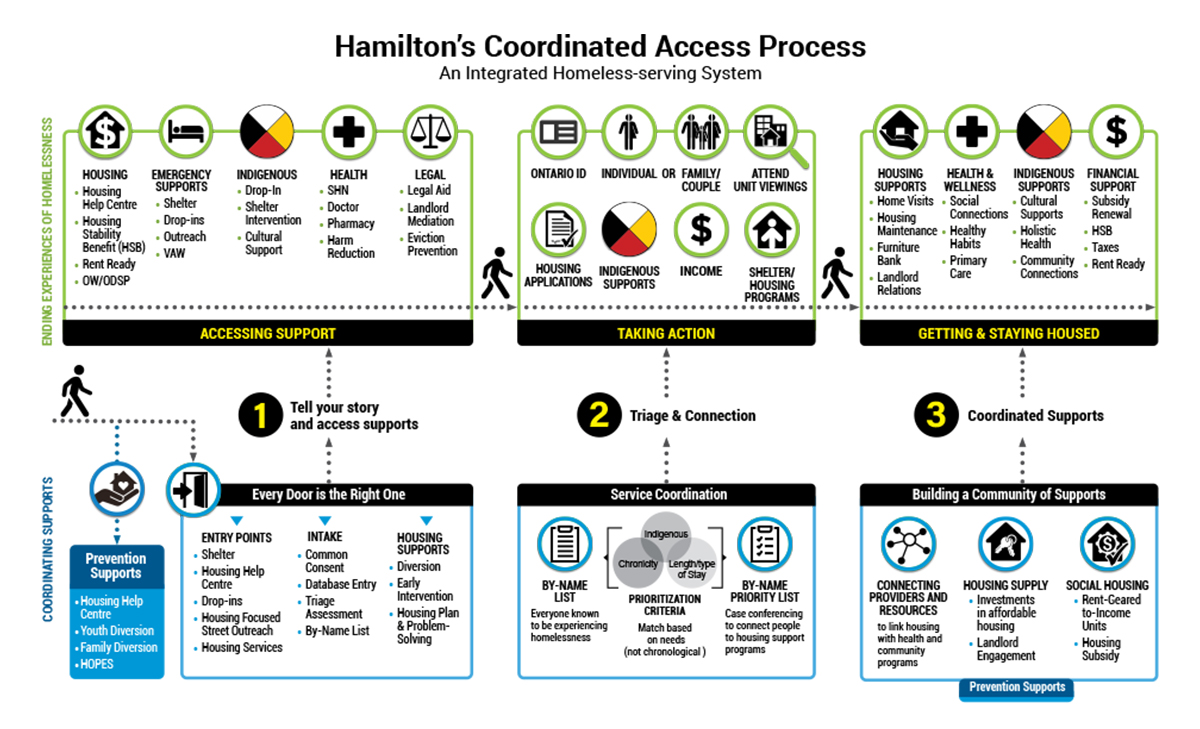
Process map

The number of people who experience homelessness or are at risk of homelessness varies from year to year. Changes in how we collect data and other factors such as shelter capacity and housing options impact the way we interpret the information we collect.

Information from HIFIS over the last few years shows steady demand across the programs aimed at preventing homelessness, providing emergency shelter, and helping individuals in finding stable housing. Since 2021 an average of over 3000 unique individuals were homeless at least one day of the year:

  • 1165 people experienced chronic homelessness in Hamilton in 2024.
  • Over 1000 people were supported with one-time financial supports to prevent homelessness each quarter in 2024.
  • Each quarter in 2024 approximately 1000 people accessing drop-in programs received support with their housing needs.
  • In 2024, over 500 people receiving either Intensive Case Management or Rapid Re-Housing were placed into more stable housing.
  • Over 9000 unique individuals or households were reached by prevention programs in each quarter of 2024.

People living unsheltered. In August 2024, there were over 93 active encampment sites in Hamilton where 265 individuals were living. As of August 2025, the recorded number of people experiencing unsheltered homelessness in Hamilton was 166, and the number of recorded encampments was 55.

Housing Focused Street Outreach (HFSO) continues to work in partnership with St Matthew’s House, Hamilton Regional Indian Center, and other partners to provide direct supports to individuals experiencing unsheltered homelessness. HFSO provides human-centered system navigation for individuals experiencing unsheltered homelessness.

People with mental health and addictions. Mental health and substance use disorders can be both a contributing factor to – and a consequence of – homelessness. For those with mental health and substance use disorders, certain factors can increase the risk of homelessness including income and employment insecurity and breakdown of support systems such as family, friends, and community support.

A voluntary Point in Time Connection survey of 807 individuals experiencing homelessness in Hamilton was conducted in November 2024, confirming that both mental illness and substance use disorders are more common in the homeless population. 50% of respondents identified difficulties related to substance use and 59% reported difficulties relating to mental health.

In 2024, there were 16 unique mental health and substance use programs providing services to homeless individuals in Hamilton. These programs offered mental health support and counselling, substance abuse treatment, distribution of harm reduction supplies, and referrals for wraparound mental health services.

As housing becomes more expensive, people relying on social assistance or working in low-wage jobs are increasingly at risk of living in inadequate housing, facing housing precarity, and experiencing homelessness. In 2022, about 17,250 Hamiltonians were considered “working poor”, earning between $3,000 and $28,863 annually, often through precarious jobs with irregular hours, no benefits, and limited stability. As of March 2024, approximately 4% of Hamilton’s working-age population (15–64) accessed ODSP, slightly higher than the provincial average. Another 2% accessed OW, close to the Ontario rate of 3%.

In 2024, Hamilton’s living wage is $21.30 per hour. By comparison, Ontario’s minimum wage is $17.20 per hour, resulting in many full-time workers being unable to meet essential needs. Social assistance rates also remain far below recognized poverty measures. The Low-Income Measure, defined by Statistics Canada, for a single adult before tax is $30,401 per year or $2,533 per month. A single adult on Ontario Works receives only $733 per month in 2024. ODSP provides slightly more ($1,368 per month for a single adult household), but still well below poverty levels. The gap between income and living costs leaves Hamilton’s most vulnerable residents unable to afford stable housing as their incomes cannot cover market rents and food costs.

Addressing poverty requires coordinated action from all levels of government across a range of systems. Access to higher education and training programs can assist low-income households in finding better paying work, however, provincial and federal levels of government also control levers related to minimum wage rates, employment standards, and income tax rebates – all of which can increase income levels for people living in poverty. Targeted supports for people with low incomes is critical to preventing homelessness.

Hamilton has implemented a range of supports to help residents maintain or secure housing. Ontario Works hostel caseworkers support people experiencing homelessness to access financial assistance. The Housing Emergency Fund 
(HEF) provides emergency support to those receiving OW, ODSP, and other low-income households facing housing crises. Portable Housing Benefits have been introduced to help households afford rent in the private market. The City of Hamilton and many local organizations continue to advocate for higher social assistance rates and stronger income supports.

State of Housing

In 2021, there were 233,564 total private dwellings in the City of Hamilton. Approximately 66% of households are owner-occupied while the other 34% rent.

Hamilton is facing a mismatch between household sizes and available housing options. While most households are small (1–2 people), only about a third of the housing stock consists of smaller units. Single detached dwellings are the most common dwelling form, which tend to be larger in size and often, unaffordable. At the same time, there is a growing need for both affordable, family-sized ownership housing and larger rental units, as many larger households are being pushed into a rental market that lacks sufficient supply of 3+ bedroom units. Inclusionary zoning is identified as a potential tool to help increase the supply of affordable, family-sized ownership units. 

The City of Hamilton has an aging housing stock. In 2021, 33% of dwellings were constructed in 1960 or earlier, above the province-wide rate of 23%. Just 18% of housing was constructed between 2001 and 2021, well below the proportion across Ontario of 26%. The age of dwellings plays a role in dwelling condition, as housing requires maintenance and upkeep over the course of its lifespan. In the City of Hamilton, 7% of dwellings needed major repairs compared to 6% across the province.

Individuals with physical disabilities often need modified and accessible housing; however, most of Hamilton’s housing stock was constructed in the late 1960s and early 1970s, a time when accessibly designed buildings were not widespread. As a result, most of the housing available to those in core housing need today would not meet the current accessibility standards. The Ontario Building Code requires at least 15% of suites within a multi-unit residential building to include basic accessibility features such as a barrier-free path of travel into the kitchen, bedroom, living room, and bathroom.

The Building Code also requires that accessible suites are distributed through-out the building and represent the types and sizes of units available in the building. City Housing Hamilton – the largest social housing provider in the city – has set their own standard that 20% of suites within a multi-unit residential building are designed with basic accessibility features.

Core housing need is an indicator to determine whether housing for a private household falls below at least one of housing adequacy, affordability, or suitability.

A household is deemed to be in core housing need if it falls below one of these measures and would have to spend 30% or more of gross household income to pay the median rent of alternative local housing that is adequate, affordable, and suitable.

In 2021, 13% of residents in the City of Hamilton were in core housing need. This was above the province-wide rate of 12%. Of the households in core housing need in Hamilton in 2021, 90% faced affordability challenges. During this period 36% households in core housing need were spending greater than 50% of gross household income on shelter costs, also known as facing deep affordability issues.

34% of households in Hamilton rent, and the proportion of residents who rent has been growing in recent years. Since October 2024, advertised rent prices for vacant units are declining due to increased supply, while rents for occupied dwellings continue to rise at a slower pace than a year ago.

Rental supply in Hamilton has continued to expand, as evidenced by the significant growth in listings and the completion of new residential structures. This increase in supply has contributed to a moderation in rental market growth. In the fourth quarter of 2024, rents for units specifically designed for the rental market rose by 2%, marking a slower pace of growth compared to previous periods. Meanwhile, average condominium rents declined by less than 1% in Q4 2024 and further decreased by 2% in the first quarter of 2025. Vacancy rates have also increased, reaching nearly 3% in units designed for the rental market (purpose-built rentals) and 2% in the condominium rental segment. While purpose-built rental supply is growing, rental affordability remains a significant challenge for many residents.

The City has also experienced a shift towards denser forms of development. In 2014, single-detached dwellings made up 53% (912 dwellings) of all housing completions while apartments were just 8% (137 units) of housing completions. By 2023, single-detached completions had declined by 44%, and made up just 19% of housing completions. By comparison, apartment completions experienced an increase of 803%, making up 46% of all housing completions during this period.

As development has shifted towards denser housing forms, there has been an increase in rental housing completions. In 2014, rental housing made up just 3% of all housing completions. By 2023, this had increased to 21% of housing completions in the City. Rental housing completions reached a peak in 2021, with 624 housing completions, representing 30% of all housing completions during the period. 
Hamilton has experienced rapid changes in household characteristics in recent years. Between 2016 and 2021, renter households (+12%) increased substantially faster than owner households (+2%). As a result, there was an increased demand for purpose-built rental units. This may indicate the need for increased investment in, and development of, purpose-built rental housing. 

Subsidized housing or Rent-Geared-to-In-come (RGI) provides housing assistance to low-income residents. RGI is based on 30% of a household’s monthly income, or if the household is receiving assistance from Ontario Works or the Ontario Disability Support program, a social assistance rent scale is applied.

Ontario transferred responsibility for social housing to municipalities in 2001 and in 2011 the Housing Services Act designated 47 Municipal Service Managers, outlining their responsibilities for administration and funding. As a Service Manager, the City of Hamilton is required to fund social housing providers. In 2023, the City of Hamilton spent $49.6 million in ongoing rental subsidies, most of which was funded from the municipal levy with $11.3 million provided by federal funding.  

There are 37 unique social housing providers in Hamilton that administer approximately 11,621 social housing units. The City of Hamilton’s centralized waitlist (called the Access to Housing waitlist) is a provincially mandated list for individuals who require RGI and alternate housing assistance. Over the past five years, the number of applicants on Hamilton’s centralized waitlist has remained relatively consistent. 1,217 households on the wait-list are living in a RGI unit waiting for a transfer to another unit.


Waitlists20192022202120222023
# of households on the centralized waitlist62316647571661106258
# of households housed from the centralized waitlist59566254110821016

Most of those housed through the centralized waitlist have Special Priority Status, Urgent, or Homeless status. Special Priority Status is a provincially mandated priority for victims of human trafficking or family violence, where the applicant intends to live permanently apart from their abuser. The chronological applicants housed were primarily seniors because of the large number of social housing buildings with seniors-only mandates.

Many social housing providers in Ontario are reaching the end of their mortgages, which presents new challenges as well as new opportunities for social housing in Hamilton. At the end of their mortgage, Housing Providers have two options: continue offering social housing under a new agreement, or to meet the requirements necessary to leave Hamilton’s housing portfolio. The City of Hamilton’s End of Mortgage Strategy is designed to encourage housing providers to continue to offer affordable housing, address the long-term financial sustainability of their portfolio, and ensure that buildings are maintained.

Challenges to meeting demand for social housing include households that opt to remain in a social housing unit even when they no longer qualify for RGI assistance. At this time, the household must pay the market rent for the unit, which is typically more affordable than a private market rental. Another challenge is that fewer units are available due to the redevelop-ment of buildings and the need for major repairs. In the last five years, only 290 new units of affordable housing have been built. These factors contribute to the long-term trend of the demand for social housing exceeding supply.  

Social housing refers to buildings constructed through programs funded by the federal and provincial governments between the 1950s and 1997. Community housing is a broader term referring to any nonprofit or municipally owned affordable housing.

City Housing Hamilton’s (CHH) portfolio includes a total of 7,122 units which include1: 

  • 5,771 Rent-Geared-to-Income (RHI) units;
  • 1,352 affordable market units; and,
  • 27 commercial units.

There are 36 non-CHH housing providers accounting for a further 6,022 units of social housing in Hamilton.  
Social housing properties are often old, mostly built between 1965 - 1990, resulting in ongoing maintenance challenges. Starting in the 1990s and early 2000s, the federal and provincial governments dramatically reduced funding for social housing and transferred responsibility for existing stock onto municipalities. This contributed to a decline in the amount of social housing comprising Canada’s overall housing stock, from 6% in 1991 to 4% in 2021.

Addressing repairs and upgrades to ensure the longevity and quality of social housing units is a challenge. Resources available to the municipality to support capital repairs in social housing stock are extremely limited as historically this was a provincial or federal responsibility. The Housing Services department conducts an annual call for funding applications for capital repairs of social housing units. In 2024, 70 submissions were received from 26 different social housing providers totaling over $15 million in funding requests. However, total funding available from all sources, including other orders of government, was only $10.2 million.

The 2016 estimated capital repair costs4 for all social housing projects in Hamilton was $643 million. In the 2025 budget, Council approved approximately $1.3 million for annual municipal social housing capital repairs, roughly 1% of what is required based on the 2016 Building Condition Assessments.

In April 2023 CHH adopted its current Vacancy Management and Reset Plan which committed $5.7 million to repair 467 units of housing. Repairs are 90% complete, helping to ensure safe and affordable housing options for low-income households. CHH is on track to finish renovations in all units by the end of 2025.

Despite these challenges, new social housing projects have been developed in recent years, making a positive impact on the lives of Hamiltonians. In 2022, four new projects created a total 195 total new Community Housing units, and in 2023, two new buildings with a total of 176 units were added to the Community Housing portfolio. In 2024 CityHousing Hamilton began welcoming tenants to a new building with 24 RGI units, providing deeply affordable and supportive units are operated by Indwell, delivering wrap-around support like counselling, and addictions and mental health programming.

Review Related

Plans & Documents

HHAP Annual Report to the Province - 2015 (PDF, 1012.19 KB)HHAP Annual Report to the Province - 2016 (PDF, 1.01 MB)HHAP Annual Report to the Province - 2017 (PDF, 1002.16 KB)HHAP Annual Report to the Province - 2020 (PDF, 395.44 KB)HHAP Annual Report to the Province - 2022 (PDF, 390.95 KB)HHAP Annual Report to the Province - 2023 (PDF, 950.01 KB)HHAP Annual Report to the Province - 2024 (PDF, 1.1 MB)
Staff Report CES15033: Housing and Homelessness Action Plan - June 22, 2015Appendix A: 2014 Annual Report to the Community - June 22, 2015Appendix B: 2014 Strategy Progress Update - June 22, 2015Staff Report CS11017c: Housing and Homelessness Action Plan - Endorsement of Ph…Staff Report CS11017b: Housing and Homelessness Action Plan - Endorsement of Ph…
Housing and Homelessness Action Plan Five-Year Review (CS11017(d)) - August 2020Housing and Homelessness Action Plan Five-Year Strategy Update - August 2020Community Profiles - August 2020CFA Respondents Meeting August 2019 (PDF, 745.16 KB)CFA Respondents Q&A August 2019 (PDF, 179.22 KB)Housing and Homelessness Action Plan Summary - October 2013 (PDF, 3.29 MB)Housing and Homelessness Action Plan Report - December 2013 (PDF, 5.05 MB)Housing and Homelessness Action Plan - Talking to People - October 2012 (PDF, 2.12 MB)Examining Housing & Homelessness Environment in Hamilton October 2011 (PDF, 4.93 MB)
Learn more about Homelessness

Research & Systems Planning

Homelessness Systems Planning

Housing & Homelessness Research and Planning

The Hamilton’s Systems Planning Framework(PDF, 14.54 MB) sets a path forward to end chronic homelessness by 2025. It serves as a roadmap to guide municipal decision-makers, staff, social service providers and community organizations in addressing the needs of individuals and families who are homeless or at risk of becoming homeless.

The framework re-envisions the way services are delivered and policies are implemented across Hamilton’s homeless-serving system.

While the homeless-serving system responds to immediate needs to divert people from homelessness and rapidly houses those in need of enhanced supports, partners across the broader social safety net contribute to a sustainable, seamless response that ensures prevention and appropriate housing are in place to reduce the risk of homelessness, prevent homelessness whenever possible, or otherwise ensure it is a rare, brief and non-reoccurring experience.

 The framework serves two main purposes:

  • To detail Hamilton’s s roadmap to ending homelessness within the context of the broader social safety net; and,
  • To outline a Systems Planning Framework to guide the design of the City’s investments in homelessness and enhance overall coordination of diverse resources locally to meet systems planning goals.

Guide to Finding Housing in Hamilton for People with Disabilities(PDF, 576.65 KB)
A Guide Developed by the Accessibility Committee for Persons with Disabilities  (ACPD), and approved by Hamilton City Council on September 12, 2018, this Guidebook was made to raise awareness for the housing needs of people with disabilities as well as provide a tool to assist people, their families and the community in finding and maintaining appropriate housing solutions. For more information please contact the staff liaison for the ACPD.

Housing First Overview - May 7, 2014(PDF, 1.03 MB)
Provides a comprehensive overview of Housing First and explores the elements that are necessary for effective local implementation adhering to the guidelines and expectations communicated by the Homelessness Partnering Strategy (HPS). This presentation also outlines the Housing First Fidelity Scale, presents local Performance Targets, and shares additional links to resources.

Housing First Overview - Q&A Summary May 7, 2014(PDF, 131.47 KB)
A summary of questions and responses discussed at the May 7, 2014 Housing First Information Session hosted by the City of Hamilton, Homelessness Programs (Housing Services Division) at McMaster Innovation Park.

Homelessness Prevention Overview - June 18, 2014(PDF, 309.17 KB)
This presentation provides a comprehensive overview of expectations on homelessness prevention in the City of Hamilton.

Homelessness Prevention Overview - Q&A Summary June 18, 2014(PDF, 67.93 KB)
A summary of questions and responses discussed at the June 18, 2014 Homelessness Prevention Information Session hosted by the City of Hamilton, Homelessness Programs (Housing Services Division) at Dundurn Castle - Coach House.

Homelessness Prevention Research Brief(PDF, 371.3 KB)
A summary of the research completed on homelessness prevention as part of Phase 3 of the Community Homelessness Prevention Initiative Review.

2013 Day Services Evaluation Final Report(PDF, 782.55 KB)
The City of Hamilton's Housing Services Division has completed an evaluation of day services for people in Hamilton who are homeless or at risk of homelessness. This is the Final Report.

2013 Day Services Evaluation - City of Hamilton's Position Paper(PDF, 204.04 KB)
The City of Hamilton's Housing Services Division has completed an evaluation of day services for people in Hamilton who are homeless or at risk of homelessness. This document is a summary of the City's approach in advancing the findings of the review.

Emergency Shelters and Domiciliary Hostels Programs - Summary of Analysis Report(PDF, 252.17 KB)
The Community Homelessness Prevention Initiative Review Report includes analysis and recommendations for the two main service areas: Emergency Shelters and Residential Care Facilities Subsidy Program (formerly Domiciliary Hostels). The results of the analysis set the foundation for additional work particularly on the emerging planning for homelessness prevention. 

System Change: Service User Perspectives On the Homelessness Service System - July 2010(PDF, 234.46 KB)
This report summarizes service user feedback to be included as part of two key planning initiatives: The Blueprint for Emergency Shelter Services and The Consolidated Homelessness and Prevention Program (CHPP) Review.

Date modified
July 16, 2026
Was this information helpful?
Home

Footer (primary)

  • People & Programs
  • Home & Neighbourhood
  • Build, Invest & Grow
  • Things to Do
  • City & Council

Footer (secondary)

  • Terms of Use
  • Privacy
  • Contact Us
  • Translate
  • Accessibility
  • Media Room

Subscribe to the City of Hamilton’s updates and notifications to stay informed on latest news, events, city services and more!

Subscribe to e-Updates
  • X
  • Facebook
  • Youtube
  • Instagram
  • LinkedIn

©2024 City of Hamilton