

Construction in Your Area
Stone Church Road Feedermain
Contact Us
Winston Wang
Project Manager - Design
City of Hamilton - Public Works
Email [email protected]
Jason Ahlberg
Project Manager
WSP Canada Inc.
Email: [email protected]
The City of Hamilton's Stone Church Road Feedermain project involves the design and construction of a 1200mm diameter feedermain with a total length of 5650m, from Mud Street West and First Road West intersection to the existing Tunbridge Pumping Station. The Stone Church Road Feedermain is identified as W-24 in the City's Integrated Water and Wastewater Master Plan Update.
The proposed Stone Church Road Trunk Watermain is to service growth in the Rymal Road Planning Area and Southeast Mountain Area, and to provide additional distribution capacity for the Tunbridge Pumping Station.
The Stone Church Road Trunk Watermain construction is to:
- start at Mud Street West and First Road West
- progress along Mud Street West to Paramount Drive
- continue along Paramount Drive to Stone Church Road East
- along Stone Church Road East to the Tunbridge Pumping Station at Tunbridge Cresent
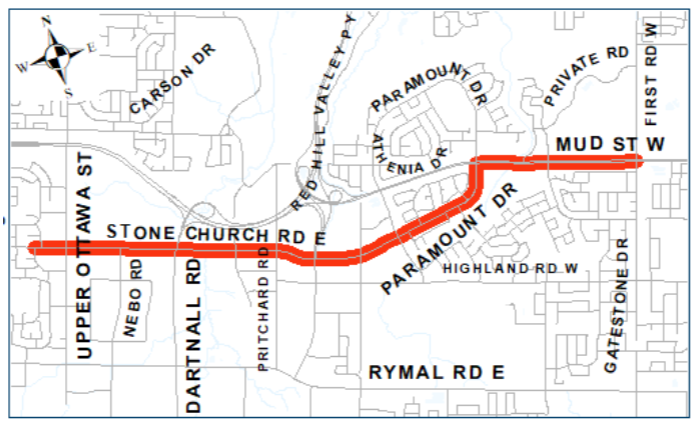
Project Area Improvements
- Construction of a 1200mm diameter trunk watermain along the Mud Street West, Paramount Drive and Stone Church Road East.
- Surface Restoration Works
Public Information Session
Held Wednesday June 24, 2026
Introduced the project, presented background information, project overview, timeline, alignment, project impacts and next steps.

Questions & Answers from Session
We understand that maintaining accessible routes is vital for local businesses and residents, and minimizing disruptions during construction is a top priority. Detailed traffic management and diversion plans are currently in the early stages of development. We are actively incorporating business access requirements into these designs. To significantly reduce impacts at this major junction, the current project plan utilizes tunneling technology at the intersection of Upper Red Hill Valley Parkway and Stone Church Road East. We will share specific detour routes and access plans with the community as soon as the detailed engineering designs are finalized.
We heard the concern over inconvenience during construction loud and clear.
Currently, detailed assessments regarding construction stage durations and associated traffic management plans are underway. The primary objective of the project planning phase is to ensure that residents maintain consistent ingress and egress throughout the construction period.
The project aims to maintain at least one lane of traffic in each direction wherever feasible. While certain localized areas may temporarily be restricted to a single alternating lane, the project team is actively working to minimize both the duration and geographic footprint of these disruptions. Specific details regarding the exact length and duration of individual feedermain segments will be finalized and communicated as the detailed engineering design progresses.
The project’s consultants are currently conducting a comprehensive traffic impact assessment. This analysis specifically evaluates optimal detour routing and the feasibility of redirecting construction vehicle traffic away from residential areas. Detailed traffic mitigation and management plans will be finalized and shared prior to the commencement of construction.
Yes, the City of Hamilton is proactively coordinating multiple infrastructure upgrades to minimize the overall duration of construction and reduce long-term disruptions for local businesses and residents. To avoid tearing up the street multiple times, the feedermain installation is being synchronized with planned road resurfacing and storm sewer upgrades along Paramount Drive, specifically between Winterberry Drive and Mud Street West. This unified approach ensures we renew critical municipal services efficiently, delivering long-term reliability while respecting the community's time and daily routines.
The phone number for the consultant project manager is 289-982-4391.
The project information will be updated on this page. The City of Hamilton’s website can be translated into 51 languages using Google Translate. This service makes City information available on Hamilton.ca available to residents and visitors who speak other languages. To choose from the list of available languages, visit: hamilton.ca/translate
We understand that predictable, timely communication is vital for helping residents and businesses plan their daily routines and operations. The City is committed to a transparent notification process at every project milestone. The Story Map on the project website will be updated on a regular basis. Currently, our engineering team is finalizing the construction phasing to establish a clear, step-by-step sequence of work. As these details become clearer during the detailed design stage, we will host our next Public Information Session (PIS) in Q4 2027, prior to the project entering the formal tendering process. Ahead of that session, we will finalize a comprehensive community communications plan to outline details for contacting businesses and institutions through advance information about this project as well as QR code along the project limits to provide advanced warning to the traveling public.
To ensure information is accessible to everyone, the City will deploy a comprehensive, multi-channel communication toolkit tailored to the needs of both residents and local businesses. As our communication plan is finalized, we will introduce a variety of digital and physical resources, including a dedicated Project Website, an interactive digital StoryMap to enhance visualization of construction phases.
For direct community outreach, we will utilize physical doorknockers featuring QR codes for instant mobile access and collaborate on updates through the Ward Councilor’s community newsletter. In addition, Billboards are also being considered for better communication along major traffic intersections. What’s more, fridge magnets are also to be prepared with QR code that can take the public to the project website with information and updates. Our goal is to provide clear, timely, and convenient access to project updates so that no one in the impact zone is left out.
Yes. The City of Hamilton is fully committed to supporting domestic businesses, protecting local jobs, and building economic resilience. In alignment with the City’s updated procurement policy and Ontario's Municipal Buy Ontario Procurement Directive, our project bidding documents will actively prioritize Canadian-made goods, services, and construction materials. Specifically, the tendering process will mandate a strict preference for Canadian steel and aluminum, ensuring that the core infrastructure for this feedermain directly invests in Canadian workers and suppliers while maintaining strict quality and safety standards.
No, existing sewers located within private properties, including those inside registered municipal easements, will not be disrupted or impacted by this construction.
The safety of students, families, and school staff is our highest priority, and we are fully committed to minimizing traffic and noise disruptions near local schools. To achieve this, our project team is actively exploring flexible scheduling and specialized construction techniques. Where feasible, we look to phase heavy construction during the summer months when schools are closed. For essential works that must occur during the academic year, we evaluate options such as night-time operations, weekend shifts, or restricted daytime construction hours to completely avoid disruptions during peak morning drop-off and afternoon pick-up times. We are coordinating directly with local school boards to ensure safe, clear access routes remain open throughout the project.
We understand that road closures heavily impact your daily commutes and neighborhood access, and our goal is to complete this work as safely and efficiently as possible. Because the project will be completed in structured segments, construction impacts on this specific section are estimated to be up to two months. This timeframe covers all major underground excavation, pipe installation, and immediate temporary road restoration. To minimize disruptions to local traffic, we will reopen the roadway on temporary pavement as soon as the underground work is safe. A final, permanent asphalt paving and neighborhood restoration phase will follow later to fully return the streets to pristine condition.
Selecting this alignment was a deliberate decision based on long-term safety, operational reliability, and a commitment to protecting our community from severe traffic disruptions. Technically, the route must connect the existing valve chamber at First Road West and Mud Street West (which draws from the Greenhill Reservoir) directly to the Tunbridge Pumping Station to secure the water supply on Hamilton Mountain. Several alignments were investigated during the preliminary design phases. To ensure safety of Operations and Maintenance teams and reduce impacts to local traffic during such activities, the current layout was selected for this major trunk watermain.
Protecting local wildlife, aquatic habitats, and the natural ecosystem is a primary focus of our engineering and design process. While standard open-cut construction will occur primarily within public road rights-of-way, the project footprint crosses two key waterways: Red Hill Creek and Felker Creek. To completely safeguard these sensitive ecosystems, we are using advanced, trenchless micro-tunneling technology to install the trunk watermain deep underground beneath the creek beds. This method avoids any excavation on the surface or inside the water, protecting fish, birds, and land animals from direct habitat disruption. Furthermore, our consulting team is actively completing comprehensive Environmental Impact Studies in direct coordination with the City’s Natural Heritage Group. Comprehensive wildlife mitigation and environmental protection plans will be strictly enforced before any work begins on-site.
Ensuring continuous neighborhood access is a critical priority for the project team. Comprehensive traffic management planning is being integrated throughout the design phase to specifically identify constraints at localized access points, such as those servicing Gerald Crescent.
The final construction phasing and staging plans will ensure that both access points are not obstructed simultaneously. Mitigation measures will be enforced to ensure residents maintain uninterrupted ingress and egress to their properties for the duration of the works.
The project team acknowledges that construction activity can temporarily impact the enjoyment of outdoor residential spaces, and comprehensive mitigation strategies will be implemented to minimize these disruptions.
The contractor is contractually required to deploy proactive dust-control measures, including regular deployment of water trucks and daily mechanical street sweepers. Additionally, all construction activities will strictly adhere to the City of Hamilton Noise By-Law regulations to manage and restrict noise levels. While some localized construction impacts are unavoidable, every effort will be made to reduce dust and noise to the greatest extent possible throughout the duration of the adjacent works.
The project has recently concluded the preliminary design phase and is transitioning into the detailed design stage. Input, feedback, and concerns gathered during this Public Information Session (PIS) are invaluable; they will be comprehensively reviewed and integrated into the engineering process to optimize the feedermain alignment and mitigate localized impacts for residents.
Furthermore, the project’s comprehensive Communications Plan and Traffic Management Plan will be dynamically updated to reflect this community feedback, ensuring robust project management, heightened transparency, and minimized disruption during construction.
The consulting team is currently conducting advanced traffic modeling simulations to precisely evaluate how construction activities will influence key intersections, including the junction at Quinn Avenue and Stone Church Road East.
Existing traffic constraints and peak congestion periods at this location are being actively factored into the development of the construction staging plans. The final Traffic Management Plan will implement targeted optimization strategies—such as temporary signal timing adjustments—to mitigate construction-related delays and maintain efficient traffic flow to the greatest extent possible.
Public safety and secure site operations are paramount. The project team is fully cognizant of the topographical constraints and steep gradient adjacent to Tunbridge Crescent.
Comprehensive risk-mitigation measures will be mandated within the Contractor’s health and safety protocols to address these specific geographic conditions. During inclement winter weather, enhanced site-maintenance procedures, including targeted salting, sanding, and specialized driver safety protocols for construction vehicles—will be strictly enforced to ensure that construction activities do not compromise the safety of the surrounding community.
The overall construction window for the project is currently projected to span from 2028 to 2031. To minimize prolonged disruptions, the project will be executed using a multi-phased approach.
While the broader project timeline is established, the specific scheduling, duration, and sequencing of work are currently being refined. Definitive timelines for individual segments will be finalized during the detailed design phase and communicated well in advance of any on-site activity.
The project team acknowledges the specific commuting requirements of residents, particularly those with fixed schedules and limited route alternatives.
A primary objective of the detailed design phase is the development of a comprehensive Traffic Control Plan specifically engineered to maintain continuous local access. While localized construction may result in minor delays, robust traffic management strategies—including flag personnel, optimized signage, and coordinated staging—will be deployed to ensure residents can reliably exit onto Paramount Drive and maintain their essential travel corridors, including access to major transit routes like the Lincoln M. Alexander Parkway and Highway 403.
Date modified