

Animal & Insect-related Diseases
Tick Types, Bites & Removal

Don’t Let a Tick Stick
In the yard or on the trails, protect yourself, your kids, and your pets. Do tick checks and know how to remove if you find one. Help spread the word! Partner organizations interested in supporting tick awareness can request a campaign catalogue. Some items available while supplies last.
Ticks can be found anywhere outdoors. They sit on tall grass and bushes and wait to attach themselves to a “host;” a person or animal passing by. Hamilton is considered a risk area for Lyme Disease given the higher chance of contact with a blacklegged tick in our area. While blacklegged ticks can be found in Hamilton, the overall risk of Lyme disease infection in Hamilton is considered low.
Ticks are increasing across Ontario due to changes to climate, forests, and land-use. Warmer winters allow ticks to survive in new northern areas and start searching for hosts sooner, leading to more tick bites.
Public Health Ontario’s Vector-Borne Disease Tool shows trends in human cases for tick diseases (Lyme, Powassan, anaplasmosis, babesiosis) as well as maps of blacklegged deer tick risk areas.
What Do Ticks Look Like?
Ticks are like insects but with eight legs not six. They are small and can be brown, black, or reddish, ranging from the size of a poppy seed to an apple seed. They have a flat, oval-shaped body before feeding and can swell to the size of a coffee bean or marble when engorged.
Different Types of Ticks
American Dog Ticks
The most common tick found in our area, they cannot transmit Lyme disease. American dog ticks are larger than a blacklegged deer tick, with light-colored markings on their backs. American dog ticks can carry the bacteria that cause Rocky Mountain spotted fever (RMSF). RMSF is rare in Ontario, but it can occur. In 2025, infected American dog ticks and human cases were found in the Long Point area. Prevent tick bites to lower your risk.
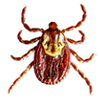
Adult Female American Dog Tick
Actual size 5mm
Does not transmit Lyme disease
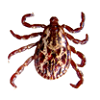
Adult male American Dog Tick
Actual size 3.6mm
Does not transmit Lyme disease
Blacklegged Deer Ticks
The only known ticks that can transmit Lyme disease in Ontario. Blacklegged ticks have been found in Hamilton. However, the risk of Lyme disease is considered low. Female blacklegged deer ticks that can carry Lyme disease are smaller than the American dog tick, with a reddish body and dark brown or black legs.
If you think you have been exposed to a blacklegged tick, contact your doctor for advice.
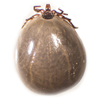
Engorged Adult Female Blacklegged Tick
Actual size up to 1.3 cm
Can transmit Lyme disease
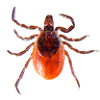
Adult Female Blacklegged Tick
Actual size 3mm
Can transmit Lyme disease
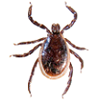
Adult Male Blacklegged Tick
Actual size 3mm
Can transmit Lyme disease
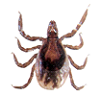
Nymph Blacklegged Tick
Actual size 1mm to 1.6 mm
Can transmit Lyme disease
(Photo credit: URI Tick Encounter Resource Centre)
Lone Star Ticks
The chance of coming into contact with a lone star tick in Hamilton is extremely low. Lone star ticks are not currently established in Ontario. While a small number have been found in Southern Ontario, sightings are rare. Most lone star ticks live in the eastern, southeastern, and midwestern United States, especially in southern states. In Ontario, most lone star ticks are found on people or pets that have traveled to areas where this tick is more common. Cases that are not linked to travel can occur, but risk remains very low.
Adult female lone star ticks have a distinct white spot (or "star") on their backs; males have scattered streaks.
How to Submit a Tick for Identification
There are two ways to submit a tick to Hamilton Public Health for identification:Send a photo through email
- Email a clear photo of the tick to [email protected] and provide the location where tick was found.
- Submit in-person to:
- Any of the Municipal Service Centres with the exception of City Hall
- Hamilton Public Health, 110 King St. West, 2nd Floor, Hamilton
To submit the tick to Hamilton Public Health for identification:
- Save the tick in a clear jar, screw-top bottle, or zip-lock bag.
- The tick must be loose in the jar, bottle, or bag.
- Do not put the tick in any liquid or attach it to paper or tape.
- Fill out all the information on the tick label
Note for tick testing:
- Public Health staff will look at and identify all ticks submitted.
- Hamilton Public Health no longer tests blacklegged deer ticks for Lyme disease if they were found on a person. Persons exposed to blacklegged ticks should contact their doctor for advice.
- Hamilton Public Health does not test ticks found on dogs or animals for Lyme disease.
- Public Health staff will call you within two to five business days to let you know the results of the identification.
Lyme disease spreads through bites from an infected tick (not all ticks are infected). However, even with a bite from an infected tick, there is only a small chance of getting Lyme disease. In most cases, ticks must be actively attached and feeding for more than 24 hours to transmit disease.
Symptoms of Lyme disease include fever, headache, fatigue, joint pain, stiff neck, and skin rash. A red rash that slowly expands around the bite can appear; learn about what this rash can look like. Symptoms of Lyme disease usually start one to two weeks after getting a tick bite but can begin as early as three days to as long as four weeks after a bite. If you have been bitten by a tick and have symptoms, see your doctor for advice. Left untreated Lyme disease can cause serious health problems.
For information about other reportable diseases in Ontario that are transmitted by ticks like Powassan Virus, Anaplasmosis and Babesios, please visit Ontario Ministry of Health Tick-Borne Diseases.
Protect Yourself from Tick Bites
Stop Ticks at the Source
Around your home, you can lower chances of contact with ticks by removing places where they like to live.
How to Check for Ticks: Remember WHAT
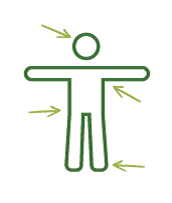
Always do a tick check after spending time outdoors. Carefully look for ticks on your body, starting with your feet and ending at your head, do not forget to also pay special attention to the groin area and knees. Remember WHAT when checking for ticks.
- Waist
- Hairline
- Armpits
- Toes
Ticks on Dogs
Dogs are very prone to tick bites. Signs a dog has a tick include finding a small, hard, dark brown or grey bump on the skin, often paired with redness, swelling, or the dog scratching/biting at the spot. Ticks are often found around the dogs’ head, ears, neck (under the collar), and paws.
Ticks on a pet can be hard to spot, especially for breeds with long and dark fur. Checking your dog for ticks when they come in from outside helps to keep them healthy. It also stops ticks from getting onto a person.
Dogs and other pets can get Lyme disease from the bite of an infected blacklegged deer tick. If you find a tick on your pet remove it right away. See your vet for more information on how to protect your pets from ticks.
How to Remove Ticks
If you find a tick on your body, remove the tick immediately to prevent infection. If a tick is attached to your skin for less than 24 hours, your chance of getting Lyme disease is small.
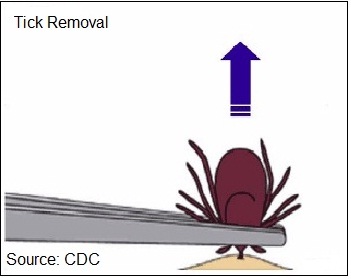
- Remove the tick carefully with fine-tipped tweezers by grasping the tick as close to your skin as you can.
- Pull it straight up, gentle but firmly.
- After you remove the tick, clean the bite with soap and water.
Note when removing a tick:
- Do not burn the tick off.
- Do not put Vaseline, alcohol, a salt stick, or any type of oil on the tick as this can irritate the tick and cause it to emit bacteria back into your blood.
- Do not squeeze or twist the tick; this could allow bacteria that causes Lyme disease to get into your body.
Date modified