

Tenant & Landlord Resources
Safe Apartment Buildings Program

Contact Us
For more information, email
[email protected]

Registration for Safe Apartment Buildings is required
The Safe Apartment Buildings By-law came into effect on January 1, 2026. Owners of apartment buildings with two or more storeys and six or more rental units that share at least one common area must register annually.
Registration for Safe Apartment Buildings is required
Hamilton’s Safe Apartment Buildings By-law 24-054 came into effect on January 1, 2026. It is designed to improve the condition of common areas in apartment buildings across Hamilton by helping the City, building owners and operators, and tenants work together to fix problems more quickly and effectively.
This By-law will help ensure safer, cleaner, and more livable housing for tenants while supporting building owners and operators in maintaining their properties to a consistent standard.
Under the By-law, purpose-built apartment buildings with two (2) or more storeys, and six (6) or more rental units which share at least one (1) common area and includes the premises on which the building is located on, must register annually. Building owners must also create plans that show how they keep the building well-maintained.
Certain condominium rental properties are also subject to the By-law. A condominium must register if it:
- Is registered as a condominium corporation under the Condominium Act, 1998;
- Has all units owned by the same person or related persons;
- Has a majority of units that are rental units; and
- Contains two (2) or more storeys and six (6) or more rental units that share at least one (1) common area.
The Safe Apartment Buildings By-Law does not apply to:
- Condominiums that do not meet the above criteria
- Long-term care homes
- Licensed residential care facilities
- Licensed retirement homes
- Lodging homes
- Housing co-operatives
Information for
Property Owners & Tenants
Registering Your Property/Properties
Registration for the Safe Apartment Buildings Program is now open. You will need create an account or login to your existing account to complete the registration.
Visit my.hamilton.ca/SafeApartments to complete your registration
Deadline: The deadline for building owners to register each apartment building they own was February 28, 2026. To remain compliant with the by-law, you must submit your full registration package. Property managers can complete registration on the owner’s behalf, but the owner is legally responsible for compliance.
Before You Begin: Prepare Your Registration Package
To ensure a smooth registration process:
- Review the draft Registration Form and Building Owner Guide before starting your registration.
- Gather all required documents and information in advance. Once you begin a registration in the portal, you cannot save and return later – it must be completed in one session.
- Submit a complete registration package. Partial or incomplete submissions will not be accepted.
- Prepare a separate registration package for each building you own or manage. Each building requires its own registration.
When ready, log in to my.hamilton.ca to provide
- Completed registration form with:
- Owner and operator information
- Building contact details
- Security features
- General building information (number of rental units, amenities, etc.)
- Legal description of the building (can be found on your property tax bill)
- Proof of general liability insurance with a minimum per-occurrence limit of $2,000,000
- Mandatory plans for:
- Cleaning
- Electrical maintenance
- Managing disruptions to vital services (planned and unplanned)
- Maintaining the building in of good repair (including a five-year forecast of capital and common element repairs and improvements)
- Pest management
- Waste management
- Payment of the registration fee
- For 2026, the fee is $60 + HST per unit
- You will be invoiced after your registration documents have been received and reviewed
Social housing providers and providers receiving a rent supplement from the City of Hamilton must register, but they do not have to pay the annual registration fee for any rent supplemented units. They are still responsible for any fines, fees, penalties, or other charges.
Important Information for Building Owners/Operators
- If you own more than one apartment building, you must register each building separately
- Registration is valid for one year and must be renewed annually
- Failure to register a building may result in an order and fines for non-compliance
- You cannot rent a unit to a new tenant if:
- There is an active property standards order against the unit
- Vital services (such as heat, water, or electricity) are not available
- You know the unit has a pest problem
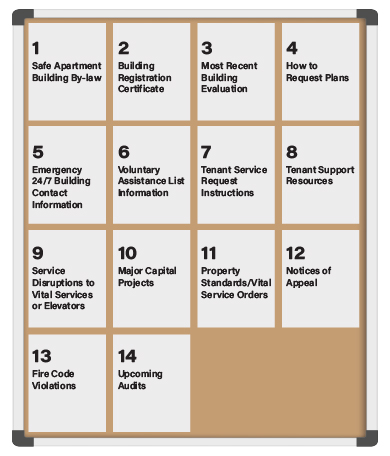
Under the Safe Apartment Buildings By-law 24-054, the following documents and information must be posted on each apartment building’s Tenant Notification Board:
- Information about the Safe Apartments Buildings By-law 24-054*
- A copy of the Safe Apartment Buildings By-law Registration Certificate*
- A copy of the most recent Building Evaluation results*
- Instructions on how to request copies of each Plan required by the By-law
- Name and 24-hour contact information of the building’s Emergency Contactperson
- Information about the Voluntary List of Tenants Needing Special Assistance, including its purpose and how tenants can request to be added to the list
- Instructions on how to submit and follow up on Tenant Service Requests, including how to submit unresolved issues to the City by:
- Email: [email protected]
- Phone: 905-546-2782, option 1
- Online: By-law Complaint Form
- Tenant Support Resources:
- Information from the City regarding tenant rights, eviction prevention, and tenant support resources, and how to access this information in multiple languages
- Information on City air-conditioned locations: hamilton.ca/heatlandlord, including how to access this information in multiple languages*
- Information about planned or unplanned disruptions to vital services, including the nature of the disruption, expected duration, and any affected rental units
- Information about major capital projects that are being planned or underway, including, the nature of the project, expected duration, and any affected rental units
- Any Property Standards or Vital Service Orders or Notices issued by the City^
- Any Notice of Appeal related to an order
- Information about any Ontario Fire Code violations^
- Notice of any upcoming building audits to be completed by the City^
Additional Notes
- Items marked with * are documents provided by the City or available for download from the City of Hamilton website.
- Items marked with ^ represent documents or noticed that may be issued to the building (or building owner) when applicable.
Example of tenant notification board
Once a building is registered, City Municipal Law Enforcement Officers will complete an evaluation to assess the building’s overall condition and maintenance practices.
Evaluations include:
- Inspecting the building interior and exterior common areas
- Reviewing records and service request processes
- Speaking with tenants if needed
- Assigning an evaluation score
Each building will receive an evaluation score based on these findings. The score determines when your next evaluation will be scheduled. You must fix any issues identified during an evaluation.
Evaluation Score and Next Steps:
- 85% or higher: Next evaluation in 3 years
- 51% to 84%: Next evaluation in 2 years
- 50% or lower: An audit will be scheduled
Building Evaluation scores must be posted on the Tenant Notification Board inside the building and will be published on the City’s website.
Audits
An audit will be conducted if your building scores 50% or lower.
- Audit fee: $2,123 + HST (fees may increase annually under the City of Hamilton’s User Fees and Charges By-law)
Audits include:
- Inspection and assessment of building’s physical condition
- Unit-by-unit inspection based on tenant reports
- Tenant engagement (door knocking)
- Review of building standards and record-keeping
After the audit, you must fix all by-law violations. Audit results will be made public.
Evaluation Elements
During the building evaluation, Officers will inspect building elements as applicable, included but not limited to:
| Category | Examples of Elements Evaluated (not limited to listed items) |
|---|---|
| Exterior Grounds |
|
| Exterior Building Surface |
|
| Building Entry and Exits |
|
| Building Safety and Security |
|
| Waste Storage Area |
|
| Other Property or Building Amenities |
|
| Graffiti |
|
| Lighting |
|
| Elevators |
|
| Stairwells |
|
| Roof |
|
| Interior Commons Areas |
|
| Laundry Room and Common Bathrooms |
|
| Storage Areas and Locker Rooms |
|
| Mail Areas and Rooms |
|
| Underground Parking Garage |
|
| Mechanical Equipment and Service Areas |
|
| Presence of Pests |
|
| Tenant Notification Board |
|
| Procedures |
|
| Required Plans |
|
The by-law requires every apartment building to have written plans. These plans set minimum maintenance standards and help keep buildings in good condition.
In addition to creating the required plans, building owners, operators, or landlords must:
- Hire certified tradespeople where required by law (for heating, ventilation, air conditioning, plumbing, etc.).
- Keep records of all maintenance activities to show the plans are being followed.
- Provide copies of plans to tenants upon request or before repairs or treatments occur.
Integrated Pest Management Plan
This plan explains what owners, operators, landlords, and tenants must do to prevent and manage pest infestations.
Your plan must include:
- Inspection Schedule: Preventative inspections every three months in all common areas, and units as needed. This also includes monitoring the age and condition of the building to reduce potential entry points and prevent pest access.
- Response Time: Action within 72 hours of a Tenant Service Request regarding pests.
- Treatment Protocols: Standard treatment steps for each pest type (e.g. ants, bed bugs, cockroaches, fleas, hornet/wasp, rodents)
- Containment Measures: Procedures to prevent pests from spreading to other units.
- Follow-Up: Inspection within 15-30 days after treatment.
- Record Keeping: Maintain logs of inspections, treatments, and tenant notifications.
- Tenant Communication: How tenants will receive a copy of the plan and educational materials before treatment.
- Tenant Responsibilities:
- Report pests immediately.
- Avoid creating conditions that attract or harbour pests (e.g. clutter, food waste).
- Treat pets for fleas, lice, or ticks.
- Maintain records of all inspections, treatments, and tenant notifications.
Sample Integrated Pest Management Plan
Waste Management Plan
This plan explains how your building will meet City requirements for garbage, recycling, organics, bulk items, and other waste types. It shows compliance with the Property Standards By-law 23-162 and Solid Waste Management By-law 20-221. Your plan must include:
- Collection Schedule: Dates and times for garbage, recycling, organics, and bulk items.
- Waste Sorting Areas: Show where bins and containers are located inside and outside the building.
- Bulk Item Process: Storage and disposal procedures between collection days.
- Waste Chutes and Loading Areas: Include details about waste chutes and loading areas if applicable.
- Tenant Education: Place posters in common areas showing sorting instructions.
- Resources: Sample posters and guidelines at hamilton.ca/ApartmentWaste.
- New Buildings: Those built or approved after November 2021 must follow the City’s Waste Requirements for Design of New Developments and Collection.
For more details, visit hamilton.ca/ApartmentWaste or email [email protected].
Cleaning Plan
This plan explains how you will keep the building clean and safe. Your Plan must include (but is not limited to):
- Inspection Schedule: Frequency of checks for cleanliness in common areas.
- Cleaning Schedule: How often common areas will be cleaned, and methods used.
- Emergency Cleaning: Steps for addressing spills, hazards, or health risks promptly.
- Documentation: Logs of inspections and cleaning activities.
State of Good Repair Plan
This plan outlines the major repairs and improvements needed over the next five years to keep the building in good condition. It also covers work needed to protect or fix the building, make sure vital services continue to work, improve, or maintain security, and ensure people can move around safely.
Your plan must include a list of the building’s major capital and common elements, including:
- Roofs
- Elevators
- Building exterior (facades)
- Windows
- Major mechanical systems (heating, cooling, ventilation)
- Garages
- Interior flooring and wall finishes
- Balconies
- Guardrails
- Stairwells and handrails
- Building access and emergency exits
Sample State of Good Repair Plan
Electrical Maintenance Plan
This plan explains how the building’s electrical systems will be safely inspected, maintained, and monitored. It can be developed in collaboration with a Licensed Electrical Contractor (LEC) or engineer with relevant experience in maintenance planning practices and must be maintained by an LEC holding a valid ECRA/ESA licence. Your plan must include:
- Working with a licensed ECRA/ESA electrical contractor to maintain the plan.
- A schedule for regular inspections, testing, and maintenance of electrical systems and equipment.
- Procedures for monitoring electrical system conditions and identifying issues proactively.
- Tenant notifications for any planned electrical work or service interruptions.
Up-to-date records of all inspections, maintenance activities, and repairs, must be maintained and provided to the City upon request.
Refer to the Guide to Multi-Residential Electrical Maintenance to develop your Plan:
Electrical Safety Authority (ESA) Development Plan Guidance
Vital Service Disruption Plan
This plan explains how you will ensure tenants have continuous access to vital services as required by the Vital Services By-law 23-161. Vital Services include:
- Hot and cold water (continuous and uninterrupted hot water must be at least 43°C)
- Fuel
- Electricity
- Gas
- Heat (minimum of 20°C from September 15 to May 15)
Your plan must include:
- How you will communicate service disruptions to tenants, including:
- Posting notices on the Tenant Notification Board within 24 hours of any unplanned disruption
- Posting notices at least 24 hours before any planned service disruption
- Preventative measures to reduce the risk of service interruptions.
- Steps you will take to restore services quickly and keep tenants safe during outages.
- A process for how the plan will be implemented during a prolonged service disruption.
To stay compliant after successfully registering your building, building owners/operators must:
- Follow the mandatory plans submitted during registration
- Provide copies of plans to tenants upon request or when doing related work
- Set up a process to receive, address, and record Tenant Service Requests
- Keep records of all Tenant Service Requests and maintenance activities for at least 30 months from the record creation date
- Maintain a voluntary contact list of tenants who need additional assistance during emergencies or service disruptions
- Install and maintain a Tenant Notification Board in a common area that is easy for tenants to access. Keep the board up to date with information that affects tenants
- Use a certified tradesperson where required by law
- Provide City staff access to the building for inspections, evaluations, audits, or compliance checks
- Notify the City within 7 days of any changes to building registration plans, contacts, or ownership by emailing [email protected]. If building ownership changes, a new registration is required.
Building owners must not rent or offer to rent a vacant unit if:
- The unit does not meet minimum maintenance standards under the City’s Property Standards By-law
- There are property standards orders issued against the unit
- Vital services to the unit have been discontinued
- There is a known pest infestation in the unit
Resources
Safe Apartment Buildings Building Owner Guide Safe Apartment Buildings Registration Form - Reference Only Sample Pest Management Plan Sample Buildings Cleaning Plan Sample State of Good Repair Plan Sample Vital Service Disruption Plan Sample Waste Management Plan Voluntary List of Tenants - Template Tenant Service Requests - Template Safe Apt By-law Information - Poster Tenant Rights - Poster Cooling Locations - Poster
Date modified